
Architecture
Understand Kandev's process, code, runtime, persistence, event, protocol, and trust boundaries.
Kandev is a server-first development workbench. The released application is a single native Go binary with the compiled web frontend embedded. It serves the web UI, HTTP API, WebSocket API, and MCP endpoint from one backend listener. Agent processes run behind an agentctl sidecar in local, worktree, container, or remote task environments.
Read this page in order
- Start with the process diagram.
- Follow backend ownership and task runtime to find the code that owns a behavior.
- Use the protocol and event sections for cross-process contracts.
- Check trust boundaries before changing credentials, executors, providers, or MCP.
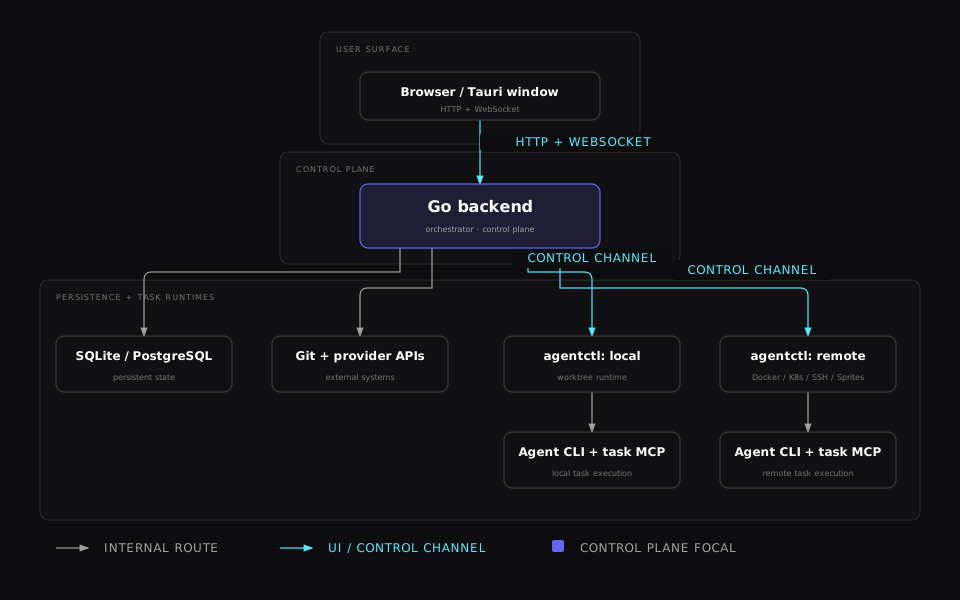

The diagram separates the user surface from the Go control plane and the task
runtimes below it. The backend owns the durable state and external provider
boundary; agentctl owns the local or remote agent process and task MCP.
Processes and launchers
apps/backend/cmd/kandev/main.go is the shipped entry point. Normal arguments enter the native launcher in apps/backend/internal/launcher/; the hidden __backend mode enters the composition root in apps/backend/internal/backendapp/.
These adjacent launch layers have different jobs:
apps/backend/internal/launcher/implements all four launch modes:dev(supervisedmake -C apps/backend devbackend + Vite dev-server child, state under<repo>/.kandev-dev/), installedrun,start, and service behavior.- The published
apps/cli/bin/npm shim selects the matching@kdlbs/runtime-*package and starts its nativekandevbinary. apps/desktop/is a Tauri shell. Rust starts its bundledkandev --headlesson an owned loopback origin and owns native windows, external links, notifications, and updates. The product UI is still the backend-served SPA.
The release build embeds generated web assets in the Go binary. make dev
instead starts Vite and configures Go to proxy it, so HTTP, API, and WebSocket
traffic still enters through Go. Installed releases do not use a separate web
server.
Backend ownership
Backend code is under apps/backend/internal/. Common owners include:
task/,workflow/,orchestrator/, andruns/for work state and dispatch;agent/for agent definitions, profiles, executor mapping, and lifecycle;agentctl/for the sidecar server, process/protocol adapters, Git, files, shell, terminal, and workspace operations;worktree/plus runtime implementations for local, Docker, Kubernetes, remote Docker, SSH, and Sprites environments;- provider domains such as
github/,gitlab/,jira/,linear/, andsentry/; mcp/for Kandev tool schemas and backend handlers;gateway/websocket/for client broadcasts;system/,persistence/, anddb/for status, storage setup, pools, and SQL dialect primitives.
internal/backendapp/ constructs these domains and registers routes, subscribers, schedulers, and startup recovery.
Layouts vary by domain. Handlers translate HTTP or WebSocket requests; some domains add controllers; services own behavior; repositories or stores own persistence; providers adapt external systems. Use the nearest established boundary instead of treating this as a mandatory global stack.
Web ownership and state flow
apps/web/src/main.tsx loads the Go boot payload, creates the Zustand state provider, and renders the shell and route dispatcher. Top-level routing lives in src/spa-routes.tsx; it is custom SPA routing, not Next.js filesystem routing. Next-shaped app/**/page.tsx files are page components.
HTTP clients in lib/api/domains/ and domain hooks in hooks/domains/ issue requests. lib/state/ hydrates and composes store slices. lib/ws/ routes live updates into that state. The backend remains authoritative; the client must recover from missed, duplicate, or stale events.
See Web development for settings and workbench ownership.
Task runtime and agentctl
A task selects repositories, an agent profile, and an executor profile. Product executor types are local, worktree, local_docker, remote_docker, sprites, ssh, k8s, and test-only mock_remote. They map to lifecycle backends standalone, docker, remote_docker, sprites, ssh, or k8s; local and worktree share a process backend but prepare different Git environments.
internal/agent/runtime/ is the intended high-level backend lifecycle facade, but it remains transitional and current callers also use internal/agent/runtime/lifecycle/ directly. Backend-side clients in internal/agent/runtime/agentctl/ reach the agentctl server implemented in internal/agentctl/server/.
Local and worktree execution share a host agentctl control server that manages multiple task instances. Container and remote backends deliver or start agentctl in the target environment. Its authenticated control and per-instance APIs own the agent subprocess, ACP adapter, workspace, Git, file, process, shell, terminal, port, and MCP relay operations. The backend, not the browser, coordinates that channel.
A worktree isolates concurrent Git state. It does not isolate processes, the host filesystem, or credentials. Containers and remote hosts add stronger runtime boundaries, but every credential explicitly delivered to an environment remains available there.
ACP, REST, and MCP
These protocols are separate:
- ACP is the structured agent-session protocol. The current agentctl adapter factory accepts ACP.
- REST and WebSocket are backend/client and agentctl control surfaces.
- MCP supplies Kandev and profile-configured tools to an agent. It is not an agent runtime adapter.
agentctl hosts task MCP endpoints and relays tool calls over the agent stream to backend handlers. The backend also exposes external MCP routes. Those routes remain open while authentication is disabled; when the experimental authentication feature is enabled, they require an authenticated identity and carry that user into dispatch. External clients use personal access tokens, while same-origin browser tooling can use a session. Do not expose them on an untrusted network without binding, TLS, and scoped credentials. See Automation and MCP.
Events and persistence
The event bus provides live fan-out to WebSocket broadcasters and backend subscribers. It uses an in-memory bus by default and can use NATS when configured. It is not durable replay: persist a transition before publishing, make consumers tolerate duplicates and reconnects, and recover from the database.
SQLite is the default database; PostgreSQL is supported. There is no central migration-file framework. Domain repositories/stores initialize fresh schemas and apply ordered, inline upgrades at startup. internal/persistence/ opens the database, maintains boot metadata, and records the current binary version after repository initialization succeeds; internal/db/ provides pools, rebinding, and dialect helpers.
Keep long-running provider or agent work outside transactions. Persist stable IDs and explicit statuses so startup recovery can reconcile partial execution. See Backend development for migration rules.
Trust boundaries
Review each crossing explicitly:
- browser or desktop window to backend;
- backend to provider APIs and Git remotes;
- backend to agentctl and a task environment;
- agentctl to the selected agent and MCP servers;
- host to Docker, Kubernetes, SSH, Sprites, or other remote infrastructure.
Validate scope and identity server-side. Treat provider text, repository content, agent output, URLs, archives, paths, and command arguments as untrusted. Never rely on a frontend-only permission check.
apps/backend/internal/office/ contains feature-flagged, in-progress autonomy work. Its source tree is not a supported extension API for the regular task product.