Git Operations
Use Kandev worktrees, commits, remote operations, change requests, and cleanup safely.
Kandev runs Git commands in the selected repository workspace for a task session. The Worktree executor gives a session a dedicated host worktree; Local uses the configured shared checkout, while container and remote executors use runtime-specific workspace behavior described in Executors. The browser sends a WebSocket request to the backend, which forwards it to agentctl in that executor. This keeps the command's filesystem, Git configuration, network access, SSH agent, and provider CLI in the same environment as the agent.
Use the task's Changes panel to inspect, stage, discard, commit, push, reset, or rename a branch. The task toolbar and command panel also expose Commit Changes, Push, Pull, provider-appropriate pull-request or merge-request creation, Rebase, and Merge when a Git-capable session is selected.
Quick path
- Inspect the selected repository in Changes.
- Stage only the files you intend to commit.
- Run required checks before pushing or opening a change request.
- Treat discard, reset, amend, force-push, and cleanup as irreversible or history-changing operations.
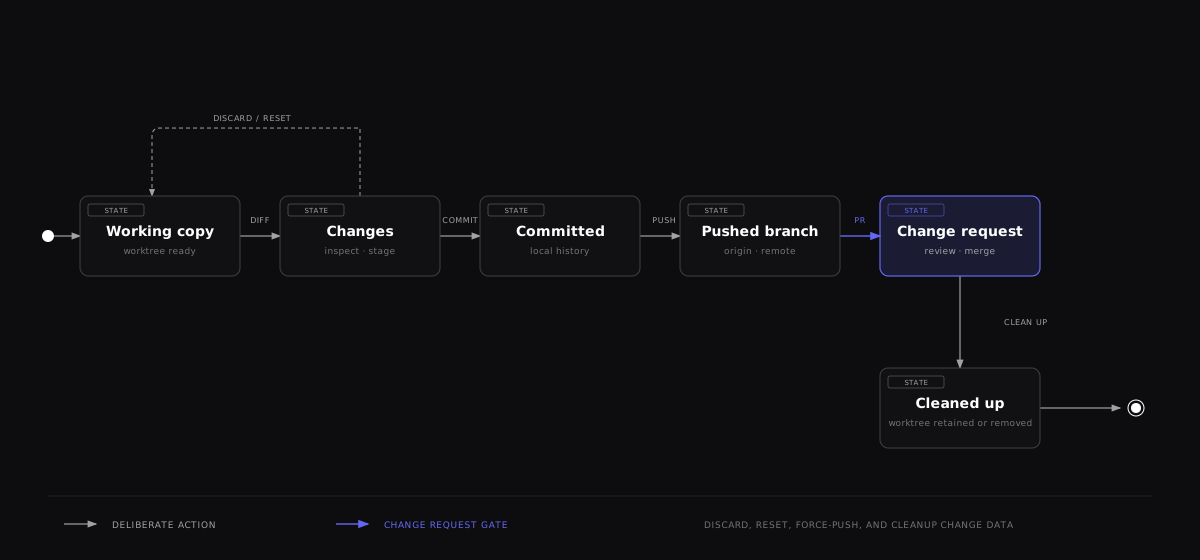

The state transitions are separate operations. Inspect the diff before staging, verify checks before pushing, and decide whether cleanup may remove a worktree or other local data.
When task and PR histories differ
For an associated pull request, Kandev keeps the task checkout and the published PR history separate when their commit histories differ. It may identify a completed local rebase when the current repository evidence supports that explanation. If the evidence is missing or incomplete, Kandev uses neutral wording instead of guessing which history changed.
Choose Compare versions first. Kandev opens Changes with the task and PR histories visible; the comparison does not fetch, rewrite, or publish Git history. Review the selected repository, branch, pull request, and both displayed heads before choosing a replacement action.
Publish task version... replaces the published PR history after an exact provider-head check and confirmation. Restore published PR version... replaces the task checkout history, creates a recovery branch at the current task head first, and requires a clean working tree. If the provider head changes before confirmation, Kandev leaves both versions unchanged and asks for a fresh review.
Prerequisites and trust boundary
The repository must be a valid Git checkout in the executor workspace and the session's agentctl must be reachable. Remote commands use the remote named origin; configure its URL and credentials in the executor where the command runs before relying on Pull, Push, or change-request creation. Rebase and Merge use origin when it exists, or a local base branch when it does not. The workspace's provider automation identity does not replace the task's Git credential policy or executor-local SSH setup; see Executors.
Git commands from the agent shell and Git actions from the Changes panel use different permission paths. The Changes panel sends its Git action through Kandev to agentctl. It does not run the action inside the agent shell. The agent shell remains subject to the selected agent's permission mode.
In a restricted agent mode, git status can work while git add or git commit fails. These write Git metadata, including .git/index.lock.
If the error says that .git/index.lock already exists or is held, another Git process can own the lock. Stop other Git operations and inspect the lock before retrying. Remove a stale lock only after you confirm that no Git process owns it. The Changes panel uses the same worktree, so it does not bypass an active lock.
If the agent cannot create .git/index.lock because its permission mode blocks the metadata write, the repository and Kandev Git integration can still work.
To commit agent edits, use the Changes panel. No mode change is needed. If the agent shell must commit, select an agent mode that allows Git metadata writes. Mode names come from the installed agent. For example, Codex can expose Agent (default) and Agent (full access).
Managed Improve Kandev tasks are the exception to the ordinary single-remote push description. The
canonical origin still identifies kdlbs/kandev for pulls, base comparisons, issue lookup, and
the pull-request target. Before launch, Kandev prepares one exact fork remote for the task branch
and configures Git to use it for pushes. Run ordinary Push or git push; do not rename origin
or replace it with a fork. The PR workflow uses the canonical repository and an explicit
<fork-owner>:<branch> head. Other tasks keep the normal origin push behavior.
Compare a fork pull request
When a linked pull request uses a fork, Kandev stores the provider-qualified target repository and target branch on the exact task-repository attachment. It then fetches that target into a comparison-only remote-tracking ref. This ref is read-only and is authoritative for Changes, commits, cumulative diff, and ahead/behind counts.
The comparison target does not replace origin, the checked-out branch, or the push route. Kandev
shows the target as <owner>/<repository>:<branch> without credentials. If the target cannot be
validated, fetched, or resolved, Kandev marks comparison as unavailable and does not substitute a
same-named branch from origin. Numeric comparison totals are hidden until the exact target is
available.
When a provider retargets the pull request, Kandev refreshes the stored target and the live session comparison. Selecting a task base branch or removing the owning pull-request association clears the explicit target. A PR with incomplete fork identity is not guessed or applied to another repository.
These UI operations enter through Kandev's /ws endpoint. With authentication disabled, anyone who can reach an unprotected backend receives the synthetic administrator identity and can invoke destructive Git actions with the executor's permissions. Experimental authentication adds user and workspace authorization, but it does not restrict the executor's filesystem or credentials. Keep Kandev on loopback or behind an authenticated, origin-protected TLS proxy; see WebSocket API.
Credentials are resolved where agentctl runs. A host SSH agent, credential helper, gh login, or az login is not automatically available inside every Docker, SSH, or remote executor. Give the executor only the repository access it needs and test with a disposable branch. See Executors for executor-specific credential handling.
When the Worktree executor is selected, its filesystem separation is not a security sandbox. Host worktrees share the repository's Git object database and local refs, and agents can run arbitrary repository commands allowed by their executor.
Managed worktree and branch lifecycle
This section describes Kandev's Worktree executor and other executor paths that create managed Git workspaces. Local, Docker, remote Docker, SSH, and Sprites have executor-specific checkout, mount, and cleanup behavior; see Executors before assuming these host paths or isolation properties apply.
By default, managed worktrees live under the configured task-data directory, commonly:
~/.kandev/tasks/{task-directory}/{repository-name}
~/.kandev/tasks/{task-directory}/{repository-name}-{branch-slug}
Additional branches are siblings of the primary repository worktree, not directories nested inside it. Multi-repository tasks have one worktree per repository. Kandev reuses a valid session/repository worktree; if its directory is missing, it attempts to recreate it from the recorded local or remote branch.
For a new task branch, the repository default template is:
feature/{title}-{suffix}{title} is an ASCII-safe, lower-case task-title slug and {suffix} is a short collision-avoidance value. Repository settings can change the template. When pull_before_worktree is omitted it defaults to true: Kandev attempts to refresh and verify the base branch before creating or recreating the worktree. The public configuration defaults both fetch and fast-forward pull timeouts to 60 seconds. When a usable local base exists, authentication, network, timeout, missing-ref, divergent-ref, and uncertain-ancestry errors produce a credential-safe warning and Kandev creates the worktree from that local base. The warning states that remote changes may be missing. When no usable local base exists, Kandev must materialize the requested branch from the remote; a failed refresh or missing remote ref stops task preparation with a repository-specific launch error. Explicit remote-only refs and remote executors keep this strict materialization behavior.
For a numbered GitHub PR, Kandev uses the current PR base when available. If Git proves that the requested PR base was deleted, Kandev can refresh and use a configured fallback branch, often the repository default, with a warning that names both branches; unproven PR refresh failures remain fatal. Kandev does not create the worktree from an unverified local or remote-tracking fallback.
If the repository is intentionally offline, open its workspace repository settings and disable Always pull before creating a new worktree. This skips the refresh attempt for host worktrees, but it is not required for a normal local-only base. Keep the setting enabled when remote freshness is important for later task launches.
Branch names in executor scripts
The repository.branch placeholder supplies an upstream branch name to executor scripts.
For example, origin/main and refs/remotes/origin/main both produce main for clone and fetch commands.
This applies to current and saved scripts that use the placeholder.
Kandev removes one recognized prefix. Names such as feature/login and upstream/main remain unchanged.
Use refs/heads/origin/topic to identify a literal upstream branch named origin/topic.
The stored task base reference and worktree.base_branch remain unchanged.
A missing upstream branch still fails preparation.
Review a PR in a remote workspace
When you select a GitHub PR for a new remote workspace, Kandev checks out the fetched PR head before the agent starts. This includes fork PRs on Sprites, Docker, SSH, and Kubernetes. Kandev fetches the PR head from the base repository and keeps the selected base branch for comparison.
Review checkout does not require permission to push to the fork. It does not configure a fork push destination or grant edit access. If the selected PR or branch cannot be fetched, preparation fails instead of starting on the base branch.
Resuming an existing workspace preserves its branch, local commits, and uncommitted changes. A newly recreated workspace fetches the selected PR again. Existing workspaces that previously started on the wrong branch are not reset automatically.
Files remain, but Git metadata is missing
A linked worktree stores its files separately from its Git administrative
directory. Its .git file points to an entry under the main repository's
worktrees directory.
An incomplete backup restore or manual metadata removal can break this link without removing the checkout files. Git pruning can also remove administrative data while a worktree drive is unavailable. This is different from a missing checkout or a lost branch.
Checkout files alone do not contain the complete Git state. They cannot restore a lost index, previous staging choices, or commits absent from the object database. Ignored files can include credentials and require the same protection as source files.
CAUTION: Do not remove the remaining checkout to clear a metadata error. It can contain the only copy of uncommitted work. Stop active sessions before manual recovery, and preserve the checkout and available repository metadata first.
For remote or container executors, the relevant filesystem belongs to that executor. An identical path on the Kandev host does not identify the same checkout.
Automatic recovery of missing linked-worktree metadata
For a selected host Worktree environment, Kandev can recover a checkout when the checkout directory still exists, its linked Git administrative directory is missing, and the recorded branch still resolves in the source repository. Local, container, SSH, Sprites, Kubernetes, and other remote executor workspaces keep their own recovery behavior. A remote Git origin does not make an executor remote.
Kandev checks every selected repository slot before it changes any slot. It keeps
the original checkout and creates a sibling recovery worktree with a branch named
{recorded-branch}-recovered-{operation-prefix}. It copies tracked, untracked,
and ignored files, deletions, modes, and symbolic links. It does not restore the
old index, staging choices, or commits that are no longer available.
Kandev refuses automatic recovery when metadata is ambiguous, the recorded branch is unavailable, the environment is busy, the environment owner changed, or the recovery claim is not current. It does not substitute the task base branch. A multi-repository recovery can retain an earlier completed slot when a later slot fails, but Kandev does not start an agent with an incomplete inventory. Recovery records and snapshots remain beside the original checkout for inspection and can contain ignored files, including sensitive data.
Named branch policies
Open Settings → Workspaces → workspace → Repositories, edit a repository, and expand Branch policies. A policy names the base branch, branch-name template, and pull-request target. Policies belong to that repository. Create, edit, and delete actions take effect immediately. The branch controls list local and remote branches. You can search the list or refresh it from Git.
The base branch is the starting point for the new task branch. The pull-request target is its merge
destination. These values are usually the same. A Gitflow Release policy can start from develop
and target main.
In New Task or New subtask, the repository branch picker shows saved policies before raw branches. Select a policy to create a fresh task branch from its base branch. The policy template controls the branch name. Raw branches keep their existing checkout behavior. Each policy uses one line in the picker. Point to or focus its information icon to see the saved values. On touch devices, tap the icon.
The Gitflow starter can create Feature, Bugfix, Hotfix, and Release policies in one operation. It requires two different existing branches and does not change Git branches. A task stores the selected policy values when it is created. Later policy edits or deletion do not change that task's branch or pull-request target. Kandev's pull-request dialog uses the saved target by default. You can select a different target before creation.
Kandev adds the saved target to the agent's task context. The instruction tells the agent to pass the
target to the provider CLI. For example, a GitHub agent uses gh pr create --base <target>. Kandev
does not add a separate shell environment value, and it does not prevent the user from changing the
target.
Policies are not available in Quick Chat, Remote, Add Sources, or Add Branch flows.
When a task opens an existing branch or GitHub PR, Kandev fetches that branch; for a numbered GitHub PR it can fetch refs/pull/NUMBER/head, including fork PRs. At materialization, Kandev uses the PR's current GitHub base when available. Polling also keeps the task's stored comparison base aligned after GitHub retargets a stacked PR. If the intended branch is already checked out in another worktree, the new worktree uses a suffixed local branch and tracks the original origin branch when available. The required-refresh rule still applies before that new worktree is created.
Tasks created without an initial title can expose the one-shot set_task_title_kandev handoff when
Settings → General → Task Actions → Agent-generated task titles is enabled. After the owning
session accepts its final title, Kandev regenerates Kandev-managed branch names from that title and
updates the stored branch snapshots. It never renames a repository row with an explicit checkout
branch (for example, a GitHub PR branch) or a Local/Local PC checkout. A branch manually selected
before the title call is preserved as well. Multi-repository tasks apply these rules independently to
each repository, and a Git or snapshot persistence failure does not undo the accepted title.
After creation, Kandev copies any repository-configured files and runs its setup script. Setup-script failure is non-fatal: the worktree remains and the session surfaces a warning. Cleanup scripts run before worktree removal, but their failure also does not prevent removal.
Deleting a task with local worktree changes
Task deletion checks every owned worktree before it changes the task or starts cleanup. If Git reports tracked or untracked changes, deletion stops and the task remains visible. The confirmation dialog lists the affected worktrees and requires an explicit choice to permanently discard those changes before a retry.
With that choice, Kandev removes the worktree and its local changes only after it passes the normal path-ownership, Git-registration, checkout-identity, shared-reference, and branch-safety checks. A branch with unique commits is preserved. If the checkout becomes dirty after admission, cleanup preserves the checkout and records a terminal failure instead of retrying the destructive operation automatically.
Everyday operations
All operations below run in the selected repository workspace.
| UI operation | Effective Git behavior | Important consequence |
|---|---|---|
| Pull | git pull origin BRANCH, optionally with --rebase. | Uses the current branch when any upstream exists. With no upstream it falls back to origin/main, then origin/master, then the current branch. It does not parse an upstream that points to a differently named remote branch. |
| Push | git push origin CURRENT_BRANCH; adds --set-upstream when requested or no upstream exists. | Force Push uses --force-with-lease, not unconditional --force. It still rewrites remote history when the lease is valid. Managed Improve Kandev tasks use the branch's prepared fork push remote instead of origin. |
| Rebase | If origin exists, fetches origin BASE and rebases onto origin/BASE. Without origin, rebases onto the local refs/heads/BASE. | Rewrites local commits. If conflict files are detected from Git output, Kandev attempts git rebase --abort automatically and returns the file list. |
| Merge | If origin exists, fetches origin BASE and merges origin/BASE. Without origin, merges the local refs/heads/BASE. | Conflicts are deliberately left in the worktree. Resolve and commit them, or use Abort Merge. |
| Abort | Runs git merge --abort or git rebase --abort. | Fails when that operation is not in progress or the repository cannot be restored. |
| Stage | With paths, git add -- PATHS; with an empty path list, git add -A. | Empty means all changes, including deletions. |
| Unstage | With paths, git reset HEAD -- PATHS; with an empty path list, git reset HEAD. | Keeps working-tree content. |
| Commit | Optionally runs git add -A, then git commit -m MESSAGE; Amend adds --amend. | The normal UI defaults to staging all when it invokes this helper. Amend rewrites HEAD. |
| Discard | Restores tracked paths from HEAD; added and untracked files are unstaged and deleted. | Removes both staged and unstaged work. Explicit paths are required, but deletion is not recoverable through Kandev. |
| Edit branch | git branch -m NEW_NAME for the current local branch. | Does not rename/delete the old remote branch or automatically repair every external reference. Push the new branch explicitly. |
Only one Git operation can run at a time for a given repository operator. A second concurrent request is rejected as “another git operation is already in progress.” Different repositories in a multi-repository workspace have separate operators.
Most Git command failures are normal responses with success:false, error, and sometimes conflict_files; they are not WebSocket transport errors. Read the result body even when the request itself completed. The web client waits 60 seconds for an ordinary Git operation.
Multi-repository tasks
In a multi-repository task, every wire request must identify one repository with its repo subpath. The workspace root is not itself a Git repository, so omitting repo normally fails. The UI handles this for you:
- Per-file Stage, Unstage, and Discard are routed to the file's repository.
- Stage All and Unstage All fan out to repositories that have files.
- Commit fans out only to repositories with staged changes.
- Push fans out only to repositories that are ahead.
- Pull, Rebase, Merge, and Abort fan out to all listed repositories.
- The multi-repository toolbar lets you select an individual repository for Commit, Push, Create PR, Pull, Rebase, Merge, or Force Push.
A fan-out can partially succeed. The UI continues after a failure and reports per-repository outcomes; inspect each repository before retrying a history-changing action.
Commit history and reset behavior
The Changes panel's session history is calculated relative to the session's recorded base commit or current merge base, so it focuses on commits created on the task branch. Kandev refreshes status and emits session Git updates after mutations, but the underlying Git repository remains authoritative.
Two similarly named actions have very different semantics:
- Revert latest commit (
worktree.revert_commit) is notgit revert. It accepts only the exact currentHEADSHA and runsgit reset --soft HEAD~1, moving the branch back one commit while leaving its changes staged. It creates no inverse commit. - Reset to commit moves
HEADto an existing 4–40 character hexadecimal commit SHA.softleaves changes staged,mixedleaves them unstaged, andharddiscards tracked working-tree and index changes. The current UI offers Soft and Hard and requires the short SHA before Hard; the wire handler also accepts Mixed and defaults a missing mode tomixed.
Do not reset or amend commits already consumed by other users unless you intend to rewrite and force-push the branch. Kandev hides some revert/reset actions for commits it knows are pushed, but that UI guard is not a repository policy or API authorization boundary.
Create a pull request or merge request
For an ordinary task, Create PR first runs:
git push --set-upstream origin HEADFor a managed Improve Kandev task, the prepared branch push remote replaces
origin for this push. Keep origin canonical and create the GitHub pull
request with the explicit fork head shown below.
It then selects a provider from the origin hostname:
| Provider | Required runtime tools | Creation behavior |
|---|---|---|
| GitHub | Authenticated gh CLI | gh pr create with title, body, current head, optional base, and optional --draft. Managed Improve Kandev uses --repo kdlbs/kandev and an explicit <fork-owner>:<branch> head. |
| GitLab | Authenticated glab CLI or the active workspace's matching GitLab PAT | Reuses an existing open MR for the same source/target or creates one with title, description, current source, explicit or project-default target, and optional draft state. The configured GitLab origin must match the HTTPS or SSH origin. |
| Azure Repos | Authenticated az CLI plus the azure-devops extension | az repos pr create with parsed organization, project, repository, source, optional target, and optional draft. |
Other remote providers are rejected by this action. A normal Git push can still work with another provider. A returned GitHub PR or GitLab MR is asynchronously associated with the originating task repository. Azure creation returns a URL but does not create a provider review association.
Title is required. Body and base branch may be empty. GitHub and Azure delegate an empty base to their provider CLI; GitLab resolves the project default branch before creation. The web UI defaults new change requests to draft and waits up to 120 seconds. Provider credentials and remote push permission must exist in the executor, and Git hooks or branch policies can still reject the push or change request.
For GitLab, Kandev preserves a self-managed connection's scheme and never retries against another host. It prefers glab when installed and uses the workspace-injected GITLAB_TOKEN REST path when the CLI is absent or its create command fails. The successful WebSocket payload keeps the compatibility field name pr_url and adds provider:"gitlab". Association runs after that response; use Link GitLab merge request if the MR was created but the link is missing.
WebSocket operation reference
These are the registered Kandev WebSocket actions. Every payload requires session_id; repo is optional only for a single-repository workspace.
| Action | Additional payload |
|---|---|
worktree.pull | rebase boolean |
worktree.push | force and set_upstream booleans; optional remote (configured remote name or exact configured push URL) and expected_branch (current-branch precondition) |
worktree.rebase | required base_branch |
worktree.merge | required base_branch |
worktree.abort | operation: exactly merge or rebase |
worktree.commit | required non-empty message; stage_all; amend |
worktree.stage | paths list; empty means all |
worktree.unstage | paths list; empty means all |
worktree.discard | required non-empty paths list |
worktree.create_pr | required title; body; base_branch; draft; response can include pr_url and provider (github, gitlab, or azure_repos) |
worktree.revert_commit | required commit_sha, which must be exact HEAD |
worktree.rename_branch | required new_name |
worktree.reset | required commit_sha; mode is soft, mixed, or hard |
The optional push target fields apply to the WebSocket action and the backend API. An explicit target uses the expected branch as the destination and does not set upstream tracking. A branch mismatch returns the expected and current branch values. Existing contribution routing takes precedence over an explicit target.
Example request and normal operation result:
{
  "id": "pull-1",
  "type": "request",
  "action": "worktree.pull",
  "payload": {
    "session_id": "SESSION_ID",
    "rebase": false,
    "repo": "kandev"
  }
}
{
"id": "pull-1",
"type": "response",
"action": "worktree.pull",
"payload": {
"success": true,
"operation": "pull",
"output": "Already up to date."
},
"timestamp": "2026-07-16T10:00:00Z"
}Read-only Git actions used by the Changes panel include session.commit_diff, session.git.commits, session.cumulative_diff, and session.git.snapshots. See WebSocket API for transport and subscription behavior.
agentctl also implements /api/v1/git/* HTTP routes inside the execution runtime. Those routes are an internal backend-to-runtime control surface, not the public Kandev backend API. External clients should not discover or expose executor-local agentctl ports; use the registered Kandev WebSocket actions.
Cleanup and data loss
Worktree cleanup audits the Git worktree and checkout before it runs the repository cleanup script. It then removes the Git worktree directory and may remove the local branch:
- Normal task deletion audits each owned worktree before mutation. Tracked or untracked changes stop deletion and keep the task, checkout, and local branch in place until the user explicitly consents to discard them. With consent, cleanup removes the checkout only after the normal ownership and identity audits pass. A clean branch is removed only when its current commit is already contained by the recorded base or repository default; a clean branch with unique commits is preserved after its checkout is reclaimed. Remote branches are never deleted.
- Reset Environment is allowed only when no task session is
STARTINGorRUNNING. It can optionally push first; a failed requested push aborts the reset. Teardown removes the worktree, preserves unpublished or ambiguous local work, and removes a Kandev-owned local branch only when its exact head is already contained in the recorded integration ref. The next launch materializes a fresh environment. - Office handoff cleanup uses the same fail-closed local-branch policy when it releases a worktree.
Archive cleanup uses that policy too. If a task is archived before integration, the branch remains. A later full storage-maintenance run can revisit a bounded set of those archived rows and remove the exact local ref after integration is proven. Ref deletion includes the expected head SHA, so an external branch update causes retention instead of deleting the changed ref. Kandev never removes a remote ref through this cleanup.
Before deleting a task or performing a hard reset, commit and push anything you need. Without discard consent, Kandev does not start a cleanup job when the audit finds uncommitted or untracked work. With consent, cleanup scripts run only after the normal worktree audit and perform transient teardown; files they create are removed with the audited checkout. If an audited cleanup script fails, Kandev logs the failure and continues with the same recorded worktree. An audited directory is removed through its pinned no-follow handle, and un-audited fallback cleanup can remove a managed directory without following replacement links. Git metadata is then pruned. Registration pruning and local-branch deletion are verified before the durable cleanup job succeeds; a partial failure remains retryable.
Troubleshooting
- No agent/client available: launch or prepare the session and confirm its executor is healthy. Workspace Git actions can reconstruct runtime control after a backend restart, but still need a valid task environment.
- Remote/authentication error during worktree preparation: test
git fetch origininside the same executor workspace. Verify the remote URL, SSH agent or key, known-hosts entry, token or credential-helper availability, DNS, and firewall access there. Do not paste command output containing tokens or authenticated URLs into a task or issue. - Noninteractive Git authentication failure: Kandev-owned Git commands finish with a bounded error when the selected executor credential source cannot authenticate. Repair the SSH, credential-helper, or eligible host GitHub access in that same executor and retry the operation. Kandev does not replace credentials or switch transports after the failure. Existing host bridge registration can recover on a later operation; when registration was skipped, launch, resume, or prepared-start re-evaluates it. See Choose task Git credentials for the credential scope.
- Comparison target unavailable: local Changes and local file status remain usable while a fork comparison target is unavailable. The target's commits, diff, ahead/behind values, and numeric totals remain unavailable until authentication recovers. Refresh Changes or request fresh status to trigger the one explicit re-evaluation; Kandev does not substitute a same-named
originbranch. - Host GitHub SSH setup: for host-based Git credentials, run
gh config set git_protocol ssh --host github.com, restart Kandev, and retry the task. For Docker, SSH, or Sprites, configure the same Git and SSH access in that executor instead of relying on the host. - Merge or Rebase without
origin: the selected base branch must exist locally. If it does not, Kandev returnsbase branch "BASE" does not exist locallybefore changing history. Iforiginexists, Kandev does not fall back to a local branch after a fetch or authentication error. - Pull fetched the wrong branch: Kandev always uses
originand, once any upstream exists, the current local branch name. Align local and remote branch names or use an explicit terminal command. - Rebase failed but no rebase remains: detected rebase conflicts are auto-aborted. Use the returned
conflict_files, resolve with a manual workflow, or merge instead. - Merge remains conflicted: this is expected. Resolve and commit, or choose Abort Merge. Do not start another Git operation until the repository is consistent.
- Change-request creation failed after push: the branch may already be remote. Fix
gh,glab, GitLab workspace-token, orazauthentication as applicable, then retry without assuming the push was rolled back. GitLab retries reuse an existing open MR with the same source and target. - Operation timed out: inspect status before retrying. A client timeout or lost WebSocket response does not prove the underlying command did nothing.
- Multi-repository operation failed at workspace root: choose the repository in the toolbar or include its exact
reposubpath in the request. - Missing work after cleanup: inspect a retained local branch or the remote branch if it was pushed. On unarchive, Kandev recreates a safely compacted managed branch from its recorded exact head before trying remote recovery. Task deletion may already have force-deleted the local branch.
Related guides: Configuration, Executors, Operations, and WebSocket API.