
Automation and MCP
Create scheduled, GitHub, or webhook automations and connect agents through task, profile, and external MCP.
Kandev has several mechanisms that can act without repeated manual setup. Their scopes and trust boundaries differ:
| Mechanism | Purpose |
|---|---|
| Workflow events and actions | React to an existing task entering a step, receiving a message, or completing an agent turn. |
| Workspace automations | Create task-backed work from a schedule, GitHub pull request, webhook, or manual trigger. |
| Task MCP | Give an active Kandev session task, plan, conversation, and coordination tools. |
| Office MCP and runtime CLI | Give an Office run a restricted coordination surface and permission-checked commands for Office state changes. |
| Profile MCP | Add third-party MCP servers to one agent profile, subject to executor policy. |
| External MCP | Let a client outside a task configure Kandev and create or manage work through the backend. |
Use workflow events for predictable transitions on existing work. Use a workspace automation when an external signal must create new work. MCP is a tool interface, not a scheduler.
Across Kandev's task, configuration, external, and Office MCP modes, each tool call is validated against that mode's live tools/list schema before its handler runs. Missing required fields, wrong types, declared constraint violations, and unknown top-level fields return a tool error without performing the requested action. A missing-field error names each absent schema property, but never echoes submitted argument values. Nested configuration maps still accept arbitrary keys when their schema defines them as open.
Create an automation in configuration chat
Ask configuration chat to create a workspace automation, for example:
“Create a daily progress report at 09:00 UTC.” The chat can use
create_automation_kandev after discovering the workspace and any workflow,
repository, agent, or executor profiles it needs.
The tool requires workspace_id and name. It accepts the existing automation
creation fields, including prompt, repository/base-branch selections, target
mode, continuation policy, concurrency limit, and initial triggers. A scheduled
trigger uses config.cron_expression and optional config.timezone.
New automations are enabled. Each trigger has its own enabled value, which
is false when omitted. Creation does not manually start a run, but an enabled
trigger can fire as soon as its conditions are met. The default target is a
hidden automation run with no repository, a new task for each firing, and one
concurrent run. The normal_task target requires a workflow.
The result includes the saved automation ID and triggers, plus the webhook secret revealed on creation. Later reads redact that secret. You can inspect or edit saved automations with the existing settings tools or automation editor. Creation is not idempotent, so inspect saved automations before retrying an uncertain result. This creation tool is available to configuration chat only.
Task creation boundaries
Task creation depends on the caller surface and the destination workspace:
| Caller | Creation path | Allowed destination |
|---|---|---|
| Kanban task session | create_task_kandev | Authorized Kanban workspaces |
| Office run | Office skills and injected $KANDEV_CLI kandev task create | The Office workspace and runtime scope |
| External MCP client | Existing create_task_kandev | Authorized Kanban or Office workspaces |
Office sessions do not receive an MCP task-creation tool. A direct backend call from an Office session is also denied. External MCP uses the same create_task_kandev contract for both workspace modes, subject to the client's authorization. The workspace_mode argument controls materialized workspace behavior, not Kanban or Office mode. agent_profile_id selects a launch profile and is not an Office assignee.
The optional workspace_mode field advertises exactly two values: inherit_parent reuses the parent's materialized workspace/worktree and requires parent_id; new_workspace requests a separate workspace/worktree. Omitting the field for a subtask selects inherit_parent. There is no unconditional schema default for top-level tasks.
Omit workspace_mode to use defaulting instead of sending an empty string. MCP schema validation rejects empty, whitespace-only, and padded values before backend dispatch, even though the backend policy resolver still trims strings. shared and shared_group are not supported by this MCP endpoint.
Quick path
- Use a workflow event for predictable transitions on existing tasks.
- Use a workspace automation when a schedule or external signal should create work.
- Use task MCP for tools inside an active agent session.
- Use profile MCP to add servers to an agent profile.
- Use external MCP to expose Kandev tools to third-party clients.
- Treat credentials delivered through any MCP or executor profile as available to the receiving agent.
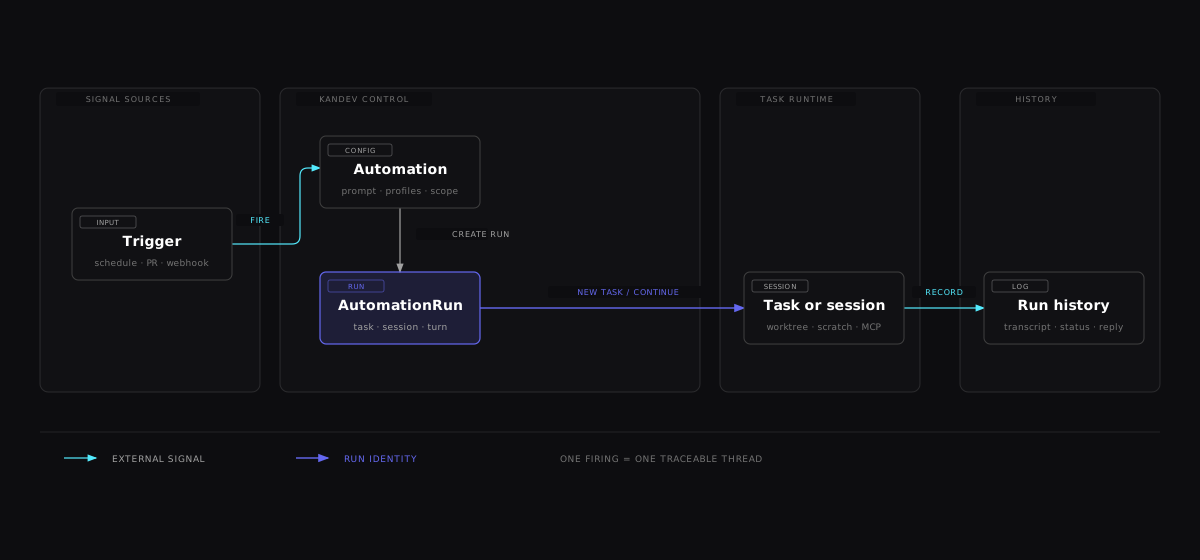

Every firing gets a traceable run identity. The task destination and context setting determine whether Kandev creates a new thread or continues the previous session.
Workflow events and human gates
Regular workflow entry actions can enable plan mode, reset agent context, or auto-start an agent; auto-start can use the step prompt or a stored prompt override. Turn-start and turn-complete events can move the task, while turn-complete and step-exit actions can disable plan mode. There is no regular standalone stop agent or send prompt workflow action. Approval/review steps and steps without automatic start remain the supported human gates. Inspect events on both the source and destination step before enabling a move or automatic start; otherwise two steps can form a loop.
See Tasks and workflows for event configuration and defaults.
Create a workspace automation
Open Settings > Workspaces > Workspace > Automations (/settings/workspace/{workspaceId}/automations) and select New Automation. The top-level /settings/automations route redirects to, or asks you to select, a workspace.
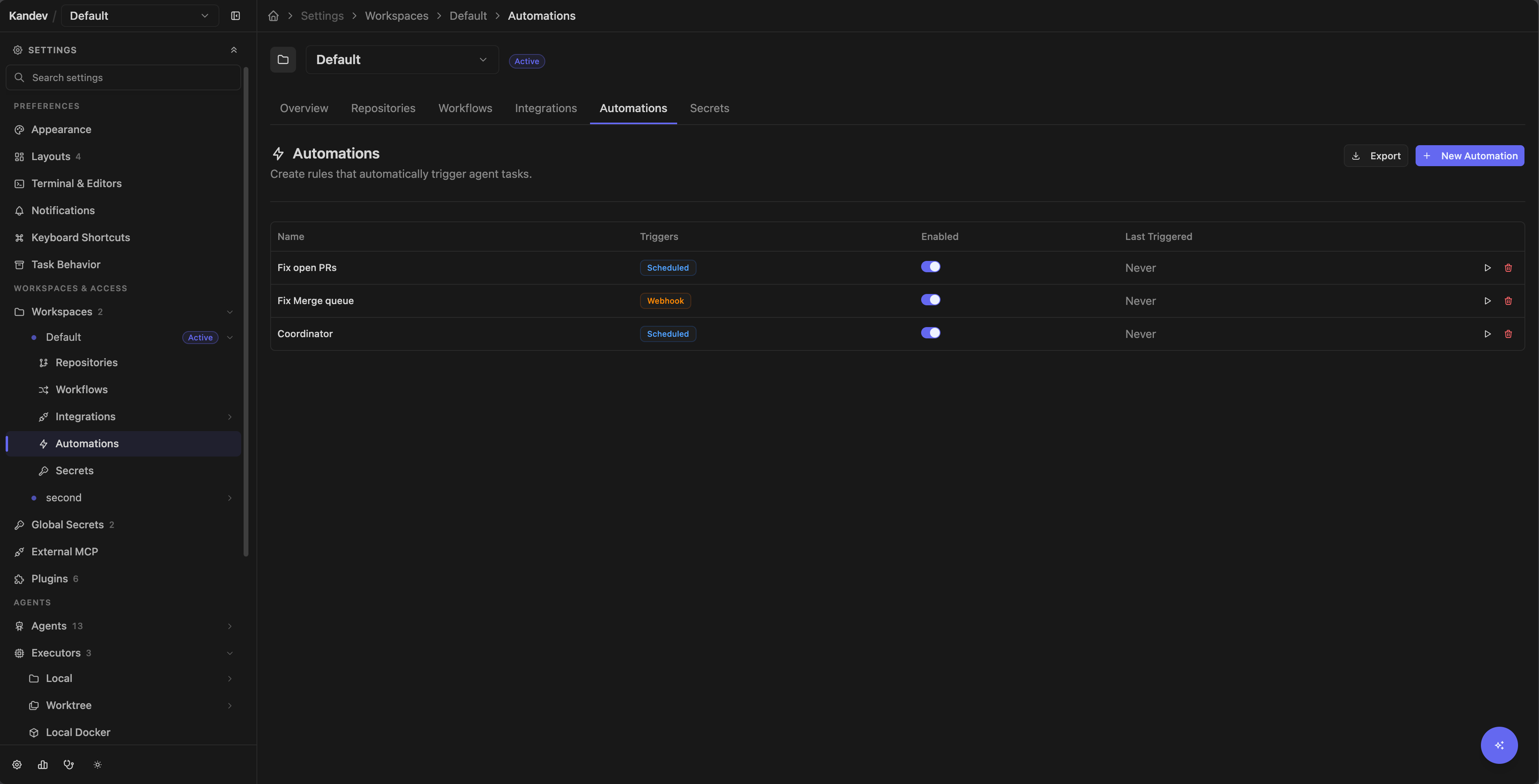
- Enter a required name and optional description.
- Select an agent profile and executor profile. Passthrough profiles are not offered. Worktree and Local-compatible profiles can run without a repository in a task-owned scratch workspace.
- Choose the run destination:
- Run in automation history only keeps each generated task out of Kanban and the sidebar. Workflow selection is optional.
- Create a normal task creates ordinary workflow work that appears in Kanban and the sidebar. A workflow is required; an empty starting step uses that workflow's configured starting step.
- Add one or more repository and base-branch pairs, or leave the list empty. The selector is the same searchable paired-chip control used by New Task. A discovered repository is registered in the workspace when the automation is saved. An empty list uses a task-scoped scratch workspace and does not create a Git worktree. Kandev never selects the workspace's first repository for you.
- Enter a prompt and optional task-title template.
- Choose Context between runs:
- Start a new task for every run creates a separate task, conversation, and task environment for each firing. In the hidden destination, those tasks do not appear in Kanban or the sidebar; in the normal-task destination, they do.
- Continue the previous session reuses one task, primary session, conversation, and worktree across firings. The destination and exact repository/base-branch pairs remain part of continuation compatibility.
- Keep the default maximum concurrency of 1 unless parallel work is safe. Reused sessions always use one active run.
- Choose a schedule and optional GitHub condition, or switch to webhook mode.
- Save, use Run now on the automation's page, then read what it said before widening credentials or scope.
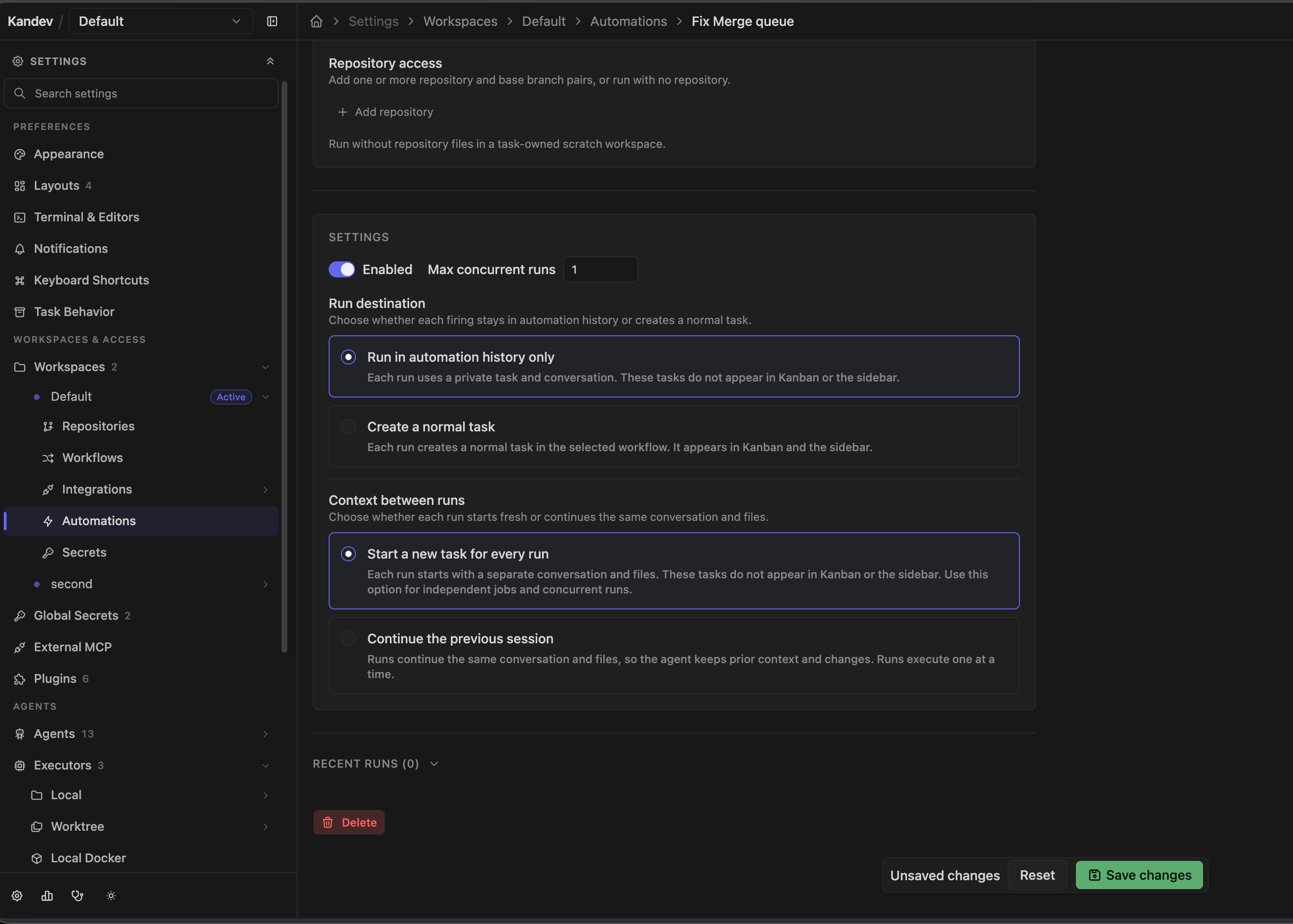
The form can save an empty agent or executor selection, but launch still needs a usable profile. Scheduled, manual, webhook, and provider-triggered runs can remain repository-free. When a provider event supplies an exact repository through its established contract, Kandev uses that event context. A GitHub pull-request run with configured repository access checks out that PR's head branch and uses its base branch.
What a firing produces
Every firing produces a distinct AutomationRun with exact task, session, and turn identity. A hidden destination uses origin = automation_run; that origin, not is_ephemeral, keeps its persistent task out of Kanban and task lists. A normal-task destination uses a separate visible automation origin, enters the selected workflow at its configured start step, and follows the ordinary task lifecycle. The workflow selector shows the same ordered step preview as New Task; automations do not have a separate step selector. The trigger is the start signal, so the agent starts immediately rather than waiting for a workflow step's auto_start_agent action.
With Start a new task for every run, each firing gets its own task, primary session, worktree or scratch workspace, and conversation. With Continue the previous session, the first firing creates one task and later firings send a new turn to its primary session. Kandev does not reset or rebase a reused checkout. If the saved task, session, runtime, or task environment is missing or incompatible, the firing creates a replacement thread and records that action on the run. A reused task keeps its creation title; each run keeps its own rendered display_title snapshot.
A finished run parks in WAITING_FOR_INPUT rather than COMPLETED, so you can reply to it and the agent continues in the same session and worktree. A run is a thread, not a receipt. Worktrees are retained for the ten most recent finished task IDs of each automation and reclaimed beyond that, so an older run stays readable but can no longer be answered.
The run destination and ordered repository/base-branch pairs are explicit saved settings. Existing empty repository selections migrate to scratch execution; there is no workspace-default fallback. Existing selected repositories use their configured default branch until the automation is saved with an explicit branch. Changing the destination, workflow, repository pairs, or runtime profiles replaces an incompatible reusable continuation on its next firing. Visible automation tasks survive automation deletion; hidden tasks use the automation cleanup lifecycle.
Selecting a run opens the complete shared transcript and focuses its exact turn. Replies sent from that transcript create a new turn in the same conversation and remain visible; run selection does not filter away newer replies.
A run cannot wait for a permission response. Kandev rejects the request and marks the run failed. Use only a profile whose intended, constrained actions can complete without a prompt.
Trigger behavior
The editor has two exclusive layouts:
- Scheduled: one schedule plus at most one GitHub condition;
- Webhook: one authenticated webhook trigger. Switching to webhook deletes the schedule and condition, and switching back deletes the webhook trigger.
In the current backend, the schedule and GitHub PR condition are independent triggers. A non-empty schedule creates generic scheduled runs, while the PR trigger separately polls GitHub. Adding a PR condition does not constrain the scheduled run. Clear the schedule expression if the automation should run only for matching PRs.
Schedule
The scheduler checks every 30 seconds and computes each expression's next calendar fire time in its configured timezone. A schedule created part-way through the day first fires at its next scheduled occurrence after creation (not immediately). A schedule missed while the backend was stopped fires once on the next check rather than once per missed occurrence.
Use the supplied presets: every 5, 15, or 30 minutes; hourly; every 6 hours; daily; or weekly. The backend also accepts @every followed by a Go duration, @hourly, @daily, @weekly, and step forms such as */10 * * * * or 0 */6 * * *.
The editor accepts arbitrary five-field cron text, including fixed calendar forms such as 30 8 * * *, weekday ranges such as 15 9 * * 1-5, and day-of-month schedules, all of which now fire at the correct time. A saved timezone (for example America/New_York) is honored, including that zone's daylight-saving transitions; an empty timezone means UTC, so schedules are deterministic regardless of the host clock. Scheduled runs are deduplicated per trigger per minute.
GitHub pull requests
The GitHub evaluator polls every 60 seconds and requires a working GitHub integration. It searches open PRs and supports:
- an explicit list of repositories;
- base-branch glob filters, including
*and a trailing wildcard such asrelease/*; - exact author-login filters;
- draft exclusion.
Select at least one repository. Although the UI offers All repos, an empty repository list is not evaluated, so it produces no PR runs. The editor exposes only the Opened event, but the evaluator currently ignores the saved event list: clearing that checkbox does not stop polling or firing. Disable the automation/trigger instead. The first evaluation considers every currently open matching PR rather than only PRs opened after the automation was enabled. Each matching PR is then deduplicated once per automation by repository and PR number.
The current evaluator does not apply label filters, and the current form does not offer them.
GitHub pull requests merged
The Pull request merged condition watches pull requests linked to tasks in the
automation's workspace. Select All repositories or an explicit repository list, then
optionally filter by the pull request's base branch (for example main or release/*).
Kandev uses the existing GitHub PR poller, so a merge can take up to one minute to be
noticed. There is no backfill sweep when you create or enable the condition: it fires on
the first qualifying github.task_pr.updated event. Linking an already-merged PR, or a
later sync that changes a merged PR row, can therefore qualify that task once.
Each firing creates a hidden automation run task and carries the linked task id as
{{data.task_id}}. The default prompt asks the agent to call archive_task_kandev for
that task. The backend also binds the run to the event-selected task, so a missing or
different archive target is rejected before any task is changed. An already archived
target is safe and reports already_archived.
The merge is deduplicated per automation, task, repository, and pull-request number. A concurrency-cap skip or a failure before a task is created does not consume that key, but there is no durable retry queue; another PR update must arrive for it to be tried again. Run now creates a manual run without a linked task id, so it tests the automation but does not replay a missed merge.
GitHub push and CI checks
Push and CI-check conditions are webhook-driven rather than polled. They require a workspace GitHub App connection (Settings > Workspaces > workspace > GitHub) whose installation is subscribed to the push and check_run events. When the App delivers a matching, HMAC-verified webhook, the installation is resolved to its workspace and the matching automation fires.
- Push: fires when commits are pushed to a matching branch. Configure an explicit repository list and optional branch glob filters (
main,release/*). Branch deletions are ignored. Deduplicated per repository by branch and pushed commit SHA. - CI check: fires when a check run completes. Configure an explicit repository list, the conclusions to match (defaults to
failure, which drives auto-fix-CI flows), and optional check-name and head-branch filters. Deduplicated per repository by check-run ID.
Because GitHub Apps only deliver events a user subscribed to at installation time, an App connection created before push/CI support was added must be reinstalled (or updated from its GitHub settings page) before these webhooks begin arriving. This generic CI trigger is distinct from the task-specific PR check remediation described under review features.
Webhook
After creating a webhook automation, copy its URL and one-time displayed secret. The edit page can reveal the secret again.
Send:
POST /api/v1/automations/webhook/{automationId}
X-Webhook-Secret: <secret>
Content-Type: application/json
Kandev silently reads only the first 1 MiB of the request body; it does not reject an oversized body. If that retained prefix is valid JSON, it becomes trigger data. Empty or invalid JSON is wrapped as {"body":"<raw text>"}. The endpoint always returns 200 {"status":"triggered"} for a well-formed, authenticated request, whether the delivery went on to fire, was filtered out, or was deduplicated; it returns 401 for a wrong secret, 404 for an unknown automation, and 409 when the automation or its webhook trigger is disabled.
A webhook trigger's configuration can optionally set a deduplication key, a list of filters, and a repository selector:
- Deduplication key: a dot path into the payload, for example
issue.id. A delivery whose resolved value repeats an earlier firing's is recorded as a duplicate and creates no new task. Leave it blank to fire on every delivery. - Filters: an ordered list of
{path, op, values}predicates, evaluated before deduplication and before the run's concurrency slot is claimed. Every filter must pass for the delivery to fire; a rejected delivery still returns the uniform 200 response, creates no task, and is recorded as skipped. Supported operators areeq,ne,in,not_in,exists,not_exists, andcontains; the five comparison operators other thanexists/not_existstrim and lowercase both sides before comparing, so filter values are case-insensitive. A path that does not resolve fails every operator exceptnot_exists. - Repository selector: a dot path whose resolved value is matched, exactly and case-sensitively, against one of the automation's already-configured repositories by name. Exactly one match binds that repository to the run; no match, or more than one, binds none. This is deliberately not the same resolution GitHub pull request triggers use, because the webhook route is exempt from session authentication and authorized by its shared secret alone, so a payload must never be able to name an arbitrary repository.
Make downstream actions idempotent regardless: a sender can still retry a delivery that Kandev has already deduplicated or filtered. The secret is stored with the automation rather than in Kandev's encrypted provider-secret store, and anyone with Kandev settings access can reveal it. Treat it as a credential, use TLS, keep it out of URLs/logs, and replace the automation if rotation is required.
See Firebase Crashlytics alerts for a worked example of dedup key, filters, and repository selector configured together.
Manual trigger
Run now on an automation's page and the play action in the settings table fire a run with trigger type manual and no deduplication. Use either action to test repository/profile resolution and read what comes back.
A trigger can succeed and still run nothing. A disabled automation, an already-fired dedup key, or a concurrency cap that is already reached all report skipped with the reason rather than claiming a fire. A cap skip writes a run row so the history explains itself; a disabled automation does not, since nothing was ever going to run.
Prompt and title placeholders
Every trigger supports {{trigger.type}}, {{trigger.timestamp}}, and {{data.<path>}}.
GitHub PR runs additionally support {{pr.number}}, {{pr.title}}, {{pr.url}}, {{pr.author}}, {{pr.repo}}, {{pr.branch}}, {{pr.base_branch}}, and {{pr.body}}.
Webhook runs support {{webhook.body}} and {{webhook.<path>}}. Dot segments traverse nested objects, and a numeric segment indexes an array, for example {{webhook.commits.0.message}}. Scalar values are converted to text; objects and arrays become JSON. Missing or unresolved placeholders are removed rather than sent literally.
Trigger payloads are untrusted input. Do not let a PR body or webhook field silently choose credentials, repositories, shell commands, or a production target. As a further precaution on the webhook trigger specifically, since its route is exempt from session authentication, every substituted {{webhook.<path>}} value and the whole {{webhook.body}} payload are wrapped in inline code or a fenced code block in the agent's prompt, so a payload cannot forge Markdown structure or a fake {{...}} placeholder that gets treated as another instruction. This does not apply to {{data.<path>}} values on other trigger types, whose payloads come from Kandev's own pollers rather than an unauthenticated endpoint.
Read what an automation has been doing
Automations in the sidebar lists the workspace's automations with a health dot. Picking one opens it. /automations is the agenda across all of them, what fires next, and the recent runs of every automation in one feed. /automations/<id> is one automation's conversation: it opens on the newest run's transcript, carries the run's title snapshot and a reply box, and groups runs as Running / Completed in a rail or mobile drawer. A selected open run exposes Stop current run, which cancels its exact task, session, and turn without touching another run in a shared session. Configuration is behind Details, because an automation is configured once and read continuously.
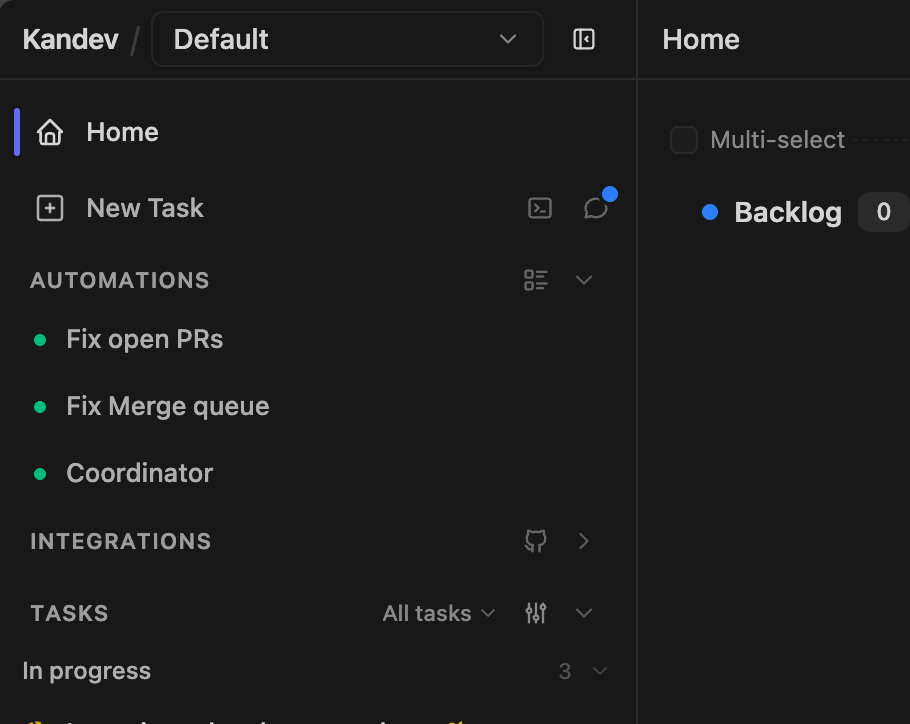
/runs still resolves to the same places, so older links keep working.
Concurrency, history, and cleanup
Maximum concurrent runs defaults to 1 and cannot be less than 1. An admitted triggered run and a bound task_created run are both open until their exact turn is settled. A run counts as active while its task is neither deleted, archived, nor explicitly cancelled, the same definition the UI uses when it says an automation will not fire because a run is still open, so the reason shown and the cap causing it cannot disagree. reuse_thread requires max_concurrent_runs = 1. When the cap is reached, Kandev records a skipped run and advances the schedule's evaluation time rather than retrying every 30 seconds.
Run history can report triggered, task_created, succeeded, failed, skipped, archived, or cancelled. triggered means that admission succeeded but task/session/turn binding is not complete. The last two are derived at read time, not stored: a task_created run whose task was deleted or whose primary session was cancelled reads as cancelled, and one whose task was archived reads as archived. That derivation is defined once and shared by every view, so two surfaces cannot disagree about the same run.
A run that produced a task opens its conversation. A run that never produced one (a skipped firing) is listed but inert; there is nothing to read.
Deleting one run also deletes its associated task when no other automation run references it. Delete all runs deletes all now-unreferenced associated tasks and history for that automation and is irreversible. Automation deletion captures referenced hidden tasks in durable cleanup jobs and retries task/worktree cleanup after the database deletion if necessary.
Continuation and fallback history
Native session continuation and provider-managed compaction remain authoritative for a healthy reusable session. If Kandev must synthesize a non-native resume prompt, it includes only the newest 50 non-empty user_message and agent_message entries, returned in chronological order and truncated per message. Tool calls, tool results, status events, and unknown event types do not appear and do not consume slots. The current firing prompt is added outside that 50-message window. Durable session history is not rewritten.
Automation coordinator MCP
Automation sessions receive one fixed, workspace-scoped coordinator MCP surface. The server resolves the trusted automation principal before dispatch and uses that principal for workspace, caller task, caller session, surface, and audit identity; a prompt or tool argument cannot forge those values. The catalog includes coordination and pending-question or permission actions needed by an automation, but excludes task deletion, configuration mutation, task-local authoring, provider PR/MR actions, diagnostics, plugins, and arbitrary capability settings.
The automation's own hidden task and every session on it are invalid targets for messaging, stopping, spawning, and blocker discovery or resolution, and for every mutation except archiving. An automation can archive its own hidden task; that is its normal end-of-run completion signal, not a self-mutation. Foreign-workspace targets return the same not-found result as unknown targets. The archive exemption covers only the automation's own hidden task; sessions on it remain invalid targets. A task spawned on another allowed task receives that target task's normal MCP profile and never inherits the automation surface. Reused worktrees are not reset or rebased by coordinator actions.
Export automations
The automations settings page (Settings > Workspaces > Workspace > Automations) has an Export control next to New Automation. It downloads every automation in the workspace as a zip, one YAML file per automation at .kandev/automations/<slug>.yml, ready to read, diff, or check into a repository. A workspace with no automations still downloads a (empty) zip rather than showing an error.
The same data is available directly over REST for scripting: GET /api/v1/workspaces/:workspaceId/automations/export returns one YAML document (application/yaml) listing every automation, and GET /api/v1/workspaces/:workspaceId/automations/export/zip returns the same per-file zip the UI control downloads (application/zip). Both are read-only and deterministic: exporting an unchanged workspace twice produces byte-identical output. A workspace you cannot access and a workspace that does not exist both return 404 with no distinguishing detail; any other failure returns 500.
Task MCP
Kandev automatically injects a task-aware MCP server into supported agent sessions. You do not need to add it to the profile. It lets the active agent use current IDs and structured operations instead of inferring board state from text.
Manage linked pull and merge requests
Task MCP provides one shared contract for GitHub pull requests and GitLab merge
requests. Use get_task_change_requests_kandev to read the current task's
linked requests, automation settings, and provider capabilities.
Use manage_task_change_request_kandev with operation set to link, unlink,
or replace. Every mutation needs task_id, provider (github or gitlab),
the canonical repository_id, and a positive request number. A number by itself
is rejected, so a fork and its canonical repository can safely have the same
number. For example:
{
  "operation": "link",
  "task_id": "…",
  "provider": "gitlab",
  "repository_id": "…",
  "number": 42
}
replace also requires old_provider, old_repository_id, and old_number.
Replacement supports one provider at a time. Every successful mutation returns
the resulting active link set, and the target task must be reachable from the
the calling task's workspace. For replacement, old_provider must equal
provider; cross-provider replacement is rejected.
Use update_task_change_request_automation_kandev for an exact association or
for all current links of explicitly selected providers on the current task.
Association targets require provider, repository_id, and number. Task
targets require a nonempty providers list. Prompt overrides are task/provider
settings and can be changed only with a task target. The tool does not create
defaults for future links. The read and automation tools are bound to the
calling session's own task: they take no task_id argument, and passing one is
rejected with an error that names the argument and states the binding.
report_change_request_auto_fix_outcome_kandev is available only when GitHub is
among the task's supported providers. It reports the outcome of a server-bound
GitHub auto-fix turn; it does not report manual work or GitLab auto-fix turns.
list_tasks_kandev and list_related_tasks_kandev expose active GitHub PR and
GitLab MR associations in the provider-neutral change_requests field; the
legacy prs field remains GitHub-only for compatibility.
Unlinking changes only the active association and its matching automation state. It does not delete conversation history, terminal receipts, or the upstream pull request or merge request.
Names ending in _kandev are the canonical MCP protocol tool names. Some agent clients show or register a server-qualified alias instead. For example, a client may expose canonical step_complete_kandev as mcp__kandev__step_complete_kandev. That qualified form is client-specific, not a second tool or a universal name; use the form exposed by the active client.
Task tools use normal client discovery. When step_complete_kandev is required but is not already visible, the agent should search the active tool catalog for its canonical name. Kandev does not request eager loading through client-specific metadata.
create_task_kandev advertises prompt for instructions delivered to a newly started agent. Older callers may still send description when prompt is absent, but sending both is an error; the compatibility name is intentionally omitted from the advertised schema.
Protect task plan writes
Task plans are shared documents. Agent writes use an opaque version to detect
an intervening write. The version changes after every title or content write,
including a write that coalesces into an existing history revision. Comment and
implementation-marker updates do not change it.
Use get_task_plan_kandev before a whole-document replacement. Pass its
version as expected_version to create_task_plan_kandev or to
update_task_plan_kandev in replace mode. A new plan does not need an
expected version. A stale version rejects the write before Kandev changes the
plan or publishes a plan event.
Kandev rejects a suspiciously smaller replacement before storage. The error
includes a stable reason, the current version, and a correction. Use
edit_task_plan_kandev for a local change. It replaces one exact, unique
old_text match and preserves all other bytes, including line endings. An
empty new_text deletes the match. Ambiguous, missing, or stale edits do not
write anything.
Set allow_truncation=true only for an intentional large reduction. The
request still needs the current expected_version. Kandev checks that plan
history is available, keeps the previous snapshot, and writes the reduction as
a new revision.
Use update_task_plan_kandev with mode="append" to add a section without
reading the plan first. Kandev reads the stored plan and adds one blank line
before the fragment. Append is not idempotent. A repeated call adds the
fragment again. expected_version is optional for append mode, but a supplied
stale version is rejected.
Recover a plan revision
Use these task-scoped tools when a plan needs inspection or recovery:
list_task_plan_revisions_kandevreturns newest-first metadata without revision content. It returns 20 rows by default and accepts a cursor and a maximum page size of 100.get_task_plan_revision_kandevreturns one exact title and content, plus itsrevision_versionsnapshot token.restore_task_plan_revision_kandevrestores the selected snapshot as a new agent-attributed revision. Pass both the current planexpected_versionand the selectedexpected_revision_version.
The restore rejects a changed current plan or a changed source revision. It
preserves the source history and reports already_current without writing when
the selected snapshot already matches the current plan. These tools accept
another task ID only when that task is within the caller's reachable workspace
or task tree.
Native rich output
Task and Office agents can call show_rich_output_kandev when a workspace file,
trend, comparison, or small metric group is materially clearer as a native
presentation than as prose. The injected agent context requires this tool when
the user explicitly asks for a chart, graph, plot, or file preview and suitable
data is available. Prefer plain text or Markdown for ordinary answers. Small
row-and-column comparisons should remain Markdown tables; native tables would
duplicate that capability while adding another layout and accessibility
contract.
Version 1 accepts a title, an optional description, and one to four ordered blocks:
filereferences a task-workspace-relative path. It can include an optional repository discriminator, title, caption, and MIME type. Kandev never accepts absolute paths, traversal, URLs, data URIs, or inline file bytes.chartrenders a line or bar chart and includes a plain-text summary for nonvisual interpretation. Data can be supplied in either of two ways:- Inline
labelsplus 1 to 4series, with one finite numeric ornullvalue per label. - A
csvdescriptor with a workspace-relative.csvpath, optionalrepo, exactx_column, and 1 to 4 numericseriescolumn mappings. Kandev reads 1 to 100 rows in file order. Empty numeric cells become gaps.
- Inline
metricsrenders 1 to 6 plain-text label/value pairs with optional details.
Kandev renders visible x/y values and automatically shortens ISO date/time
labels, large numbers, and long categories on the axes. Tooltips retain the
original x label and full values. Give every series a clear label and include
its unit when useful, for example p95 (ms). A one-series chart displays that
label as an informational legend; a multi-series chart renders local keyboard-
and touch-operable legend filters. Those filters change only the current view,
not the persisted result or agent context.
The complete tool input is limited to 64 KiB. Titles are limited to 120 characters and the optional presentation description to 500 characters. Unknown fields and unsupported versions are rejected. Agents cannot choose HTML, Markdown, JavaScript, CSS, colors, animation, component names, or layout; Kandev owns those details so results remain consistent, accessible, and responsive.
{
  "version": 1,
  "title": "Build health",
  "description": "Latest local verification",
  "blocks": [
    {
      "type": "metrics",
      "items": [
        { "label": "Passed", "value": "38" },
        { "label": "Duration", "value": "12.4s", "detail": "Warm cache" }
      ]
    },
    {
      "type": "chart",
      "chart_type": "line",
      "title": "Runtime by run",
      "summary": "Runtime fell across the last five runs.",
      "labels": ["1", "2", "3", "4", "5"],
      "series": [
        { "label": "Runtime (s)", "values": [18.2, 16.4, 15.1, 13.8, 12.4] }
      ]
    },
    {
      "type": "file",
      "path": "reports/build.json",
      "title": "Raw report",
      "mime_type": "application/json"
    }
  ]
}
Use a CSV-backed line chart for a time series already present in the workspace:
{
  "version": 1,
  "title": "API latency",
  "blocks": [
    {
      "type": "chart",
      "chart_type": "line",
      "title": "p50 and p95 latency",
      "summary": "Tail latency fell across the recorded samples.",
      "csv": {
        "path": "reports/latency.csv",
        "x_column": "recorded_at",
        "series": [
          { "column": "p50_ms", "label": "p50 (ms)" },
          { "column": "p95_ms", "label": "p95 (ms)" }
        ]
      }
    }
  ]
}
The source file might contain:
recorded_at,p50_ms,p95_ms
2026-08-13T10:00:00Z,18.2,29.4
2026-08-14T10:00:00Z,16.4,25.1
Use the same CSV form for a categorical bar comparison:
{
  "version": 1,
  "title": "Traffic mix",
  "blocks": [
    {
      "type": "chart",
      "chart_type": "bar",
      "title": "Requests by route",
      "summary": "The API route carries most request volume.",
      "csv": {
        "path": "reports/routes.csv",
        "x_column": "route",
        "series": [{ "column": "requests", "label": "Requests" }]
      }
    }
  ]
}
CSV files must be UTF-8 text with one unique header row, no more than 256 KiB, and 1 to 100 data rows. Named columns must exist exactly. X values must be non-empty and at most 120 characters. Selected numeric cells must be finite numbers or empty; malformed rows and invalid values reject the tool call with the source row and column when available.
A completed presentation persists with the conversation and replays after a
reload. For a CSV chart, Kandev resolves selected columns during the tool call
and persists only bounded labels plus numeric or null values. It never stores
the raw CSV and never re-reads it during replay, so later edits or workspace
cleanup do not change the accepted chart.
File-preview bytes do not persist: Kandev fetches a referenced file only after the user selects Preview, and Open file uses the existing desktop or mobile file viewer. If the task workspace later disappears, the presentation remains while that file block reports that its preview is unavailable.
This is a Kandev-native MCP tool, not a portable MCP rich-content standard or an
MCP App. Portable MCP content uses protocol-level content and resource types that
multiple compatible hosts can interpret, usually with less host-specific visual
control. MCP Apps let a server supply an interactive ui:// application that a
supporting host runs in a sandbox; that enables richer interaction but introduces
a larger trust, permissions, lifecycle, and compatibility surface. Neither path
is implemented by this tool, and other MCP clients should not be expected to
render its payload as Kandev does.
Task dependencies over MCP
create_task_kandev accepts blocked_by, a list of task IDs the new task must
wait on. Two further tools manage links on an existing task:
add_task_dependency_kandevwithdepends_on_task_id, and an optionaltask_id.remove_task_dependency_kandevwith the same arguments. Removing a link that is not there succeeds.
In a task-bound session, task_id defaults to the agent's own task and may only
name that task; use depends_on_task_id for the other end. The link is
authorized against both tasks, and a link that would close a cycle is rejected
with the offending path.
Use a dependency for ordering, a subtask for decomposition. Reaching for
parent_id to express "do this one first" gets neither the start gate nor the
chain: children run whenever they are started, and a parent's completion signal
fires when all children reach any terminal state, including failure.
An agent decomposing a plan into ordered steps should create each step with
blocked_by pointing at the previous one and leave start_agent at its
default. A create that declares dependencies does not launch immediately: the
requested start is recorded and fires once every predecessor has completed
successfully, so three chained creates produce a chain rather than three agents
in the same repository at once. Pass start_when_unblocked: false to create the
links with no launch intent at all. With no blocked_by, start_when_unblocked
records nothing and the task starts or does not start purely per start_agent.
Only success resolves a link. A predecessor that fails or is cancelled leaves its dependents blocked with a reason naming it, and Kandev does not retry it or drop the link on its own.
Starting a chain step by any other means consumes its recorded start, so the gate cannot fire a second session on a task that is already running. A start that fails keeps the intent, and preparing a workspace without launching an agent does not consume it.
While a step is still waiting, update_task_kandev accepts
deferred_launch_prompt to replace the prompt it will launch with. Use it when
the brief written at creation time has gone stale. The rest of the recorded
launch (agent profile, executor) is preserved. Once the task has started the
update is rejected, because nothing would read the new prompt; send the new
context with message_task_kandev instead.
Autopilot tasks and MCP profiles
Task creation accepts one optional boolean:
mcp.WithBoolean(
    "autopilot",
    mcp.Description(
        "Start this task in autopilot mode. Default: false. The value is fixed at creation and is not inherited by subtasks. The agent does not ask the user directly; it asks its direct parent only for critical decisions.",
    ),
),
The value defaults to false. It is fixed when the task is created and is not
copied to a subtask. The task record is the source of truth after creation; a
later task update cannot switch the prompt or MCP tools between normal and
autopilot behavior.
The top-level task dialog does not expose this option. The subtask dialog has a compact Autopilot switch with help text, but the value remains fixed after the subtask is created.
Kandev builds the task MCP server from a backend-owned profile. The base
surfaces are kanban-task, office-task, configuration, and external.
Optional capability groups, such as task titles, provider automation, user
questions, and parent questions, are added or removed from that base profile.
This keeps tool discovery small and makes a context change atomic.
For a Kanban task, normal sessions receive ask_user_question_kandev.
An autopilot child receives ask_parent_question_kandev instead. An autopilot
root receives neither question tool. Kandev never registers both question
tools for one task session. Office sessions use their smaller skill/CLI
surface and do not receive Kanban task-creation tools.
An autopilot child should ask its parent only when a decision blocks useful
progress. ask_parent_question_kandev returns a question_id immediately;
the child turn then ends. The parent receives a durable question message and
answers with message_task_kandev using the child task ID and
reply_to_question_id. The child stays in the waiting-for-input state until
the correlated answer arrives, so the sidebar shows the normal question
indicator during the wait.
Create idempotency with external_id
A caller that cannot tell whether an earlier create_task_kandev call (or POST /api/v1/tasks) actually landed (a crash before recording the response or a webhook redelivery) can pass an external_id and retry safely instead of guessing. external_id is an opaque, caller-chosen string, case-sensitive and byte-exact, unique per workspace: two workspaces can each hold their own task for the same value, but a second create for a value already held in the same workspace never makes a second task there. It is validated and trimmed like other free-text fields; a value that is empty after trimming is treated as if the field were omitted.
Every create response from both the MCP tool result and the REST response body always carries two additional fields, whether or not the request included an external_id:
deduplicated:truewhen the returned task already existed for that identity,falsewhen this call created it.creation_complete:falseonly when the returned task is an existing one whose own create had not finished when observed and may still be running (it is not proof the other create is still alive; it may have crashed). Every other outcome reportstrue.
Reading the four outcomes
deduplicated | creation_complete | Meaning |
|---|---|---|
false | true | This call created the task. |
true | true | An earlier, finished create already holds this identity; that task is returned unchanged, with no new task, agent, or side effect of any kind. |
true | false | An earlier create for this identity had not finished when observed and may still be running, or may have crashed. The task is returned as-is; nothing about it is started, modified, or assumed finished. |
false | true, and external_id absent from the response | This call finished creating a task, but another actor released or reused the identity in the narrow window before settlement. The task exists and is otherwise normal; it simply is not holding that identity anymore. |
Do not react to creation_complete: false by releasing the identity and retrying. The other create may still be doing required work; releasing it out from under that work can produce two tasks for the same identity. creation_complete: false means "ask again later," not "safe to force." An operator who has independently confirmed a create is abandoned (not merely slow) can free its identity with DELETE /api/v1/workspaces/:workspace_id/tasks/by-external-id?external_id=..., which returns 204 and leaves the task itself untouched. GET the same path to look up the task currently holding an identity, including one still unsettled, without creating anything; it returns 404 when nothing holds it.
Deleting or archiving the task that holds an identity does not carry the identity forward: archiving leaves it in place, but deleting the task frees the identity for reuse by a later create. external_id cannot be changed after creation; update requests that include it leave the task's identity untouched. The WebSocket task.create action and the plugin host's Tasks().Create do not accept external_id; use create_task_kandev or POST /api/v1/tasks for idempotent creates.
A task session currently registers these tool groups:
| Group | Available operations |
|---|---|
| Board lookups and task lifecycle | List workspaces, workflows, workflow steps, tasks, agents, and executor profiles; create, update, move, archive, or delete tasks; halt all live work on a direct child. This mode does not mutate workflows, profiles, or executors. |
| Coordination | Message a task or targeted session, spawn a named session on the current or another same-workspace task, and read task conversation. See Agent Communication for delivery semantics, bidirectional reply patterns, and a worked example. |
| User interaction | Ask a structured question when the current agent/session supports it. |
| Plans | Create, get, update, and delete the current task plan; apply exact edits; list, read, and restore revisions. |
| Walkthroughs | Show, get, and delete the task's code walkthrough. |
| Relationships and workspace sources | List related tasks, add a mixed repository/folder source batch to an idle task, use the legacy one-branch tool, and change a repository's diff base. |
| Workflow signal | Signal step completion when an auto-advance step explicitly requires that signal. |
When Settings → General → Task Actions → Agent-generated task titles is enabled (the default; an
explicitly saved off value remains off), a task-mode session for a newly created task or subtask can
expose set_task_title_kandev. The first eligible session to launch atomically claims the handoff and is
prompted to call it before any other work, even though the task already has a provisional title. Use a
short title phrase targeting about six words in sentence case rather than a sentence or progress update.
The tool is omitted for ordinary tasks, tasks created while the setting was disabled, config sessions,
Office sessions, and every later session on the task, even if the owner fails before renaming it. A human
rename wins if it happens first; a late owner call returns title_not_pending, while a non-owner call
returns title_not_owner, without changing the title.
The same setting applies to ordinary Quick Chat. Quick Chat keeps its agent-and-chat-number label until the owner receives the first user request, then the owner can set a more useful title. The owner keeps the title capability while the title is pending, so a later request can retry after an ignored or failed call. Configuration Chat and Quick Terminal do not expose this capability.
When the owner accepts a generated title, Kandev also updates the names of the task's Kandev-managed branches from that final title and refreshes the session's branch snapshots. This is evaluated per repository: a repository opened from an existing checkout branch (including a GitHub PR) is preserved, as is every Local/Local PC checkout. A branch manually selected before the title call is preserved. If one managed repository cannot be renamed or its snapshot cannot be persisted, the title remains accepted and the response reports the successful, preserved, and failed branch outcomes separately.
Task identity is injected for operations that require it. Workspace, parent/subtask, executor, and task-state rules still apply.
Provider-scoped review automation tools
Task-mode review automation tools follow the providers attached to the task's repositories. Kandev computes their union when the session launches or resumes:
| Attached providers | Discoverable tools |
|---|---|
| GitHub only | get_task_change_requests_kandev, manage_task_change_request_kandev, update_task_change_request_automation_kandev, and report_change_request_auto_fix_outcome_kandev |
| GitLab only | get_task_change_requests_kandev, manage_task_change_request_kandev, and update_task_change_request_automation_kandev |
| GitHub and GitLab | The four tools above |
| None or unsupported | None of these change-request tools |
Adding a repository source successfully to an idle task can update the live session's task MCP tool list after materialization. If live refresh is temporarily unavailable, the source attachment remains committed and the next launch or resume reconciles the tool list. Tool discovery only describes the available surface; backend authorization and task/provider validation remain authoritative for every call. After an upgrade, rediscover the catalog or resume the task so cached clients use the shared names. An already-running older agentctl keeps its old catalog until it resumes on the new runtime.
spawn_session_kandev creates a named sibling session on the current task by default and can target another task in the same workspace. message_task_kandev can address a task's primary session or an explicit session ID: a running agent receives queued input, an idle/created session can be started, and a failed or cancelled session rejects the message.
Without session_id the message goes to the task's primary session. If that primary is cancelled or failed, Kandev falls back to the newest session on the task that can still take a message, so a task with a live session stays reachable after its primary was stopped. A session named explicitly by session_id is never redirected. When every session is terminal the call fails and names spawn_session_kandev, which is the way to give the task a new session.
A same-task message requires the sibling's session ID. Normal messages can cross workspaces when the sender knows the full task ID. Delivery to a running session is queued by default. When a direct child must abandon its current approach and receive replacement work now, its parent should use message_task_kandev with delivery_mode: "interrupt"; another sender receives a hard error rather than a silent downgrade, and a request that cannot dispatch safely remains queued.
Use stop_task_kandev only when the direct child should halt without a replacement prompt. It has no session selector: one call gracefully stops every execution Kandev still observes as live across the child's active sessions, including non-primary sessions. Accepted sessions become CANCELLED before runtime teardown is scheduled. status: "stopped" confirms logical cancellation and asynchronous teardown, not operating-system process exit; a child with no live execution returns the idempotent status: "not_running" without changing task or session state.
After an accepted stop, Kandev attempts to move an unarchived, non-Office task from IN_PROGRESS or SCHEDULING to REVIEW; other task states are preserved. Worktrees, task environments, commits, task records, descendants, and queued messages remain available, and the task can be started again later.
add_workspace_sources_kandev adds one or more sources to an idle task and defaults task_id to the current task. A task may also target its same-workspace direct child; Kandev verifies the calling task and session on the backend, so agents cannot provide or override that provenance. Its sources input accepts the same atomic mixed batch as the Files panel: repository sources use exactly one saved repository ID, local Git path, or remote repository locator plus branch fields; folder sources use a local path and optional display name. Repository sources work on Worktree, Local/Local PC, Local Docker, SSH, and Sprites; folders work only on Worktree and Local/Local PC. The target must be repository-backed and have no active turn or tool call. Exact normalized retries are idempotent; contradictory duplicates, unsupported, or failed sources roll back the batch.
add_branch_to_task_kandev is the Worktree-only compatibility path for adding one repository/branch during an active agent turn. It creates the worktree as a sibling under the task directory, promotes the persisted Files root to that parent, and rescans it without restarting the agent, terminals, or workspace processes. The response returns worktree_path (the exact new repository location), task_workspace_path (the Files root), and agent_cwd_changed: false; deferred pre-launch materialization omits both paths. The original repository stays a separate Git worktree, so the sibling is not reported as an embedded repository or untracked files by its Git status. Use add_workspace_sources_kandev for mixed batch attachments to an idle task. update_repository_base_branch_kandev changes the base used for Kandev's diff, not a pull request's target branch.
The HTTP equivalent is POST /api/v1/tasks/:id/workspace-sources, with { "sources": [...] }. An exact normalized retry succeeds as a no-op. It returns 400 for invalid input, 404 for a missing task/source outside the workspace, 409 for contradictory duplicates or an active task, and 422 when materialization or executor capability fails. Successful adoption publishes task.updated and session.workspace_sources.updated; clients should refresh their Files and repository state from those updates.
step_complete_kandev is registered and discoverable in every task-mode session, and in Office sessions per ADR 0015. Kandev includes its completion instruction, and acts on its signal, only on steps whose auto-advance action explicitly requires that signal: on Kanban boards this is opt-in per step, while office-default's work step ships with the requirement on. A user message arriving before transition can cancel that automatic move.
When the response says that the workflow step changed, the calling turn is stale. The error identifies the launch and current steps, and a retry in that turn cannot recover. End the turn and have the user resume the session, then complete the current step and call the tool from the fresh turn. A normal manual workflow move remains available to an operator after verifying the work and destination. This recovery path does not grant an agent automatic move authority.
When create_task_kandev.repositories[].repository_url is a canonical GitHub pull request URL or a GitLab merge request URL on the configured host, Kandev resolves the contribution before creating the task. The contribution must still be open, have a valid source branch and head commit, and permit the target project to contribute; Kandev keeps the target repository as origin, fetches the exact source commit, and routes commits to the contributor's existing source branch. The existing pull request or merge request is associated with the task and reused for later changes, so Kandev does not open a duplicate. Provider-authored title, description, comments, and diff content are not copied into trusted task context. Configure the task's Git credentials as described in task Git credentials; Kandev runs a write preflight before starting the agent.
The task server runs inside agentctl's local runtime boundary. Its MCP routes do not use a separate bearer token. Do not expose agentctl ports; rely on the executor's process/network isolation and Kandev's session scoping.
Office MCP and runtime CLI
Office MCP and runtime CLI
Office runs use a smaller MCP surface than regular task-mode sessions. The built-in Office server registers exactly these tools:
ask_user_question_kandev;create_task_plan_kandev,get_task_plan_kandev,update_task_plan_kandev, anddelete_task_plan_kandev;edit_task_plan_kandev,list_task_plan_revisions_kandev,get_task_plan_revision_kandev, andrestore_task_plan_revision_kandev;list_related_tasks_kandev;list_task_documents_kandev,get_task_document_kandev, andwrite_task_document_kandev;show_rich_output_kandev;step_complete_kandev, per ADR 0015: Kandev includes its completion instruction, and acts on its signal, only on Office steps whose auto-advance action explicitly requires that signal (office-default'sworkstep is one such step).
These tools cover human questions, the current task plan, plan edits and recovery, related-task discovery, task documents, and the step-completion signal. Office state changes use the injected $KANDEV_CLI kandev ... commands instead. An Office agent should not search for additional Kandev MCP tools: Kanban/configuration tools are task-mode only and are not registered in Office mode.
Runtime credentials
Kandev injects $KANDEV_CLI, KANDEV_API_URL, and KANDEV_API_KEY when the
Office scheduler starts an Office run. The API key is a short-lived, scoped
runtime token; it is not a personal access token or a value to create, copy,
or persist in configuration. The run also receives its agent, workspace, task,
and run identifiers automatically, and the launch context is bound to that
task.
If agentctl kandev ... reports that KANDEV_API_URL or KANDEV_API_KEY is
missing, do not set either variable yourself. A regular task session should use
its injected Kandev MCP tools. An Office-owned task must be started or woken
through Office so the scheduler can supply its signed runtime context.
Reviewers and approvers record a workflow-step verdict through the task-bound
runtime CLI. The command accepts only approved or rejected and requires a
non-empty reason:
$KANDEV_CLI kandev task decision --decision approved --reason "..."The runtime derives the task, session, and agent identity from the signed run context. A repeated decision supersedes the earlier decision for that participant and step. Comments and approval-inbox commands do not record a workflow-step verdict.
An Office run can inspect the projects in its current workspace:
$KANDEV_CLI kandev projects listAn agent with the can_create_projects permission can create a project. CEO agents receive this permission by default; other roles do not unless it is explicitly granted. --name is required, and --repository can be repeated for every repository URL or local path owned by the project:
$KANDEV_CLI kandev projects create \
  --name "Payments" \
  --description "Payment services and checkout" \
  --repository "https://github.com/acme/payments" \
  --repository "/workspace/checkout"
The optional project flags are --lead-agent-profile-id, --color, --budget-cents, and --executor-config.
Use the returned project ID when creating work in that project:
$KANDEV_CLI kandev task create \
  --title "Add payment retry policy" \
  --project "$PROJECT_ID" \
  --assignee "$AGENT_ID"
Project list and create operations are forced to the workspace in the validated Office run token; the agent cannot select another workspace in these commands. Office runs cannot create or administer workspaces. Create additional workspaces through Kandev's user-facing setup and settings surfaces.
An Office run can read tasks in its signed workspace with:
$KANDEV_CLI kandev tasks listThe command supports repeatable --status and --priority filters, plus
--assignee, --project, --sort, --order, --limit, --cursor,
--cursor-id, and --include-system. Use --cursor and --cursor-id
together to continue a page walk. The workspace comes from the short-lived
runtime token, so KANDEV_WORKSPACE_ID is not required for this command.
Taskless launch and session creation remain separate Office scheduler work.
Profile and executor MCP
Profile and executor MCP
An agent profile can add stdio, http, sse, or streamable_http servers when that agent supports MCP. The built-in Kandev task server is injected separately and cannot be replaced by a profile entry named kandev.
Stdio normally starts per session and cannot be shared. Network servers can be shared or per-session. The executor's MCP policy can deny transports/server names, rewrite URLs, or inject environment. See Agents and profiles for configuration, secret handling, and failure behavior.
Inspect one running session
Open the MCP servers explorer with the button beside the chat composer. The explorer shows attachment status for the current session and execution. On desktop, it opens a wide dialog. On touch devices, it opens a full-height drawer.
The explorer has server, tool-list, and tool-detail levels. On desktop, the server list stays visible beside the active level. On touch devices, select a server to open its tool list. Select Back to servers to return.
Select kandev after Kandev serves tools/list. The tool list is sorted and
scrolls independently from the explorer header. Each row shows the tool name
and an estimated token value. Select a tool to open its description and
arguments. Select Back to tools to return to the same list position.
The tool page shows common object properties as argument rows. It also shows plain JSON for nested or composed schemas. A tool without an input schema shows No arguments. A schema that exceeds a storage limit shows Schema too large to display.
Kandev stores at most 64 KiB for one input schema and 512 KiB for all schemas in one catalog. It stores at most 128 tools and 1,024 UTF-8 bytes for each description. Notices identify truncated catalogs or schemas.
The ~N tokens value uses o200k_base on the complete compact MCP tool JSON.
It is an estimate, not a provider context count or billing count. The agent can
use a different tokenizer or tool-loading format.
A profile server can show Delivered, connection unverified. That server
connects directly to the agent, so Kandev cannot inspect its tools/list
result, descriptions, schemas, or token estimates. The explorer still shows
safe status metadata. The built-in Kandev server becomes Connected after
protocol acceptance, either legacy MCP initialize or an accepted modern
request. It becomes Active after it serves tools/list. Missing
observation is not a failure. Red appears only for an explicit sanitized error.
The report is per Kandev session and execution. It stores only bounded, sanitized attachment facts. It does not store MCP headers, environment values, tool arguments or results, raw ACP frames, or agent output.
External MCP
External MCP
Open Settings > External MCP (/settings/external-mcp) for client-specific snippets for Claude Code, Cursor, Codex, Auggie, OpenCode, and GitHub Copilot CLI.
The recommended Streamable HTTP endpoint is:
http://127.0.0.1:<backend-port>/mcpSSE compatibility uses /mcp/sse with messages sent to /mcp/message. A reverse proxy must support long-lived streaming connections.
MCP protocol versions
The /mcp endpoint supports protocol negotiation for modern and legacy clients.
- Modern clients can select
2026-07-28withserver/discover, or send a direct request with the modern request metadata. - Legacy clients use
initializeand can negotiate2025-11-25,2025-06-18,2025-03-26, or2024-11-05. - Modern requests are stateless. They do not use
Mcp-Session-Id. - SSE remains a legacy transport. Use
/mcpwhen the client supports2026-07-28.
Automatic client negotiation depends on the client SDK. Some clients need an explicit option to enable discovery. Kandev does not enable modern protocol use for every client by default.
Agent-attached MCP servers keep /mcp, /sse, and /message on the agentctl port. The external server keeps /mcp, /mcp/sse, and /mcp/message.
Configured third-party MCP servers
Kandev delivers configured third-party MCP server definitions directly to the agent. The agent and each third-party server negotiate their own protocol and authentication.
Kandev does not upgrade or proxy configured third-party MCP servers. Their supported versions depend on the agent, client, and server.
This compatibility work does not add MCP Tasks, new OAuth behavior, or third-party MCP proxying.
External MCP exposes tools in these groups:
- workspace/workflow configuration: list workspaces, workflows, repositories, and workflow steps; create, update, delete, import, or export workflows; create, update, delete, or reorder steps;
- agents and profiles: list/update agents; create/delete profiles; list/update profiles; get/update profile MCP configuration;
- executors: list executors and profiles; create, update, or delete executor profiles;
- saved prompts: list prompt summaries without content or read one prompt by its exact, case-sensitive name; saved prompt tools are read-only;
- agent-accessible settings: search setting definitions, describe a field, list authorized resource targets, read saved values, and update declared values through one compact contract;
- tasks: list, create, move, delete, archive, or update task state; list a task's sessions; read task conversation; discover or answer pending clarification questions; and discover or resolve live agent permission requests.
Agent-accessible settings
External and task-scoped agents can use the same compact settings tools:
search_settings_kandev
describe_setting_kandev
list_settings_resources_kandev
get_settings_kandev
update_settings_kandev
Search returns metadata only. Use describe_setting_kandev for the schema,
target rules, authority, replacement behavior, and recovery guidance for one
field. Use list_settings_resources_kandev when a field needs an exact
workspace, repository, profile, task, or integration target. Then pass one
target and the declared field paths to get_settings_kandev or
update_settings_kandev.
The backend validates every target and change against the owning domain. Writes keep the existing domain authorization, reference checks, atomicity, events, and cache behavior. Saved credential values are not returned. Secret-bearing fields return redacted values or safe references, and credential enrollment, deployment-owned configuration, plugin-owned settings, client-local state, and lifecycle actions remain on their existing explicit surfaces.
The compact envelope is stable as domains grow. Agents should discover fields at runtime instead of assuming that a domain's full schema is present in the tool definition. Existing lifecycle tools and compatibility MCP tools remain available where documented.
export_workflow_kandev takes workflow_id and returns one version 2
kandev_workflow JSON document with explicit step completion booleans. It omits
instance IDs and timestamps. Pass its JSON text unchanged as document to
import_workflow_kandev when it is within the existing 1 MiB import limit.
Version 1 documents remain accepted for compatibility.
Read a saved prompt
Use list_shared_prompts_kandev without arguments to discover saved prompt names. The result
contains summaries only, so it does not include prompt content:
{
  "shared_prompts": [
    { "name": "code-review", "builtin": true, "content_bytes": 1234 }
  ],
  "total": 1
}
Use get_shared_prompt_kandev with one saved prompt name to read its full content:
{ "name": "code-review" }Names are case-sensitive. Kandev trims surrounding whitespace before lookup. The result contains
name, content, builtin, content_bytes, created_at, and updated_at; it does not expose the
internal prompt ID. An empty or unknown name returns an error without prompt content. These tools
only read saved prompts. They do not create, update, delete, or expand @name references.
Answer a pending clarification question
Use list_pending_questions_kandev when an external client needs to discover clarification
questions an agent is blocked on. All arguments are optional: workspace_id scopes the results,
created_since (RFC3339) filters by age, and cursor/limit (default 50, capped at 200) page
through results oldest-first.
{
  "workspace_id": "optional-workspace-uuid",
  "created_since": "2026-08-01T00:00:00Z",
  "limit": 50
}
Each returned bundle carries pending_id, task_id, session_id, created_at, age_seconds,
context, and an ordered questions array; each question carries question_id, title,
prompt, status, and its options (option_id, label, description).
After the person answers, pass the bundle's pending_id plus one entry per question to
answer_question_kandev:
{
  "pending_id": "bundle-uuid",
  "answers": [
    { "question_id": "q1", "selected_options": ["opt-a"], "custom_text": "" }
  ]
}
Pass rejected: true with an optional reason instead of answers to decline the whole bundle.
Exactly one caller wins a bundle: a losing call (including a REST submission racing this tool)
returns claimed: false with the winner's own recorded answer, not an error, so a caller can
always tell whether its answer landed. A pending_id that is no longer active with no winner
returns an error naming that state.
Resolve a live agent permission request
Use list_pending_agent_permissions_kandev when an external client needs to show a person the
permission prompts currently blocking a task. task_id is required; session_id is optional and
must belong to that task. An authorized task with no live request returns an empty list. Each item
contains the exact task, session, request-generation, provider-pending, and tool-call identities;
creation time and status; an allowlisted action projection; and the provider's ordered option IDs,
names, and kinds.
{
  "task_id": "task-uuid",
  "session_id": "optional-session-uuid"
}
Command text and working directory are included when safe. File contents, diffs, environment values, headers, raw MCP arguments, provider-specific fields, and option metadata are omitted. Credential-like values in presentation text are redacted, and the action reports whether its returned text changed.
After the person chooses one listed option, pass the returned identities unchanged to
resolve_agent_permission_kandev:
{
  "task_id": "task-uuid",
  "session_id": "session-uuid",
  "request_id": "kandev-request-uuid",
  "pending_id": "provider-pending-id",
  "option_id": "allow-once"
}
The mutation cannot accept a command, edited tool arguments, cancellation flag, or synthesized
option. To deny an action, select an original reject_once or reject_always option. Kandev
authorizes the task/session pair, records a durable audit claim, and only then delivers that exact
option to the current live provider request. A concurrent, replayed, withdrawn, expired, or
replaced request fails with a stable permission error and never acts on a newer request. The audit
records the resolving user, actor kind, source, option identity, time, and result, but never the PAT
record ID, credential, command environment, headers, or raw MCP arguments.
Live agentctl state is authoritative for whether a request can still be answered. Persisted message audit is authoritative for history and replay prevention, but Kandev never reconstructs an actionable request from message history after its execution is gone. These tools cover structured agent command/tool permission prompts, not Office approvals or clarification questions.
In external mode, create_task_kandev has no current task and does not accept the parent_id: "self" shorthand. Its registered top-level contract asks for a repository ID, repository URL (including a supported GitHub pull request or GitLab merge request URL), or local path; workspace and workflow resolve automatically only when unambiguous. The current handler can nevertheless accept an omitted repository and create repo-less work, which is a contract/implementation mismatch rather than a supported equivalent of the regular UI's None option. Supply an explicit repository locator for portable clients. A resolvable agent profile is required even with start_agent: false; otherwise start_agent defaults to true. To create a subtask, pass the full ID of an existing parent.
create_task_kandev accepts task titles up to 60 characters. Use a concise, few-word title and put the implementation context in description; longer titles are rejected as validation errors.
External mode has no live Kandev session, so it does not expose stop_task_kandev or other task-scoped questions, plans, walkthroughs, sibling-session spawning, targeted session messages, branch operations, or step-completion signals. Some external tools can delete or materially reconfigure data; review the client's tool approvals.
External MCP security boundary
The /mcp, /mcp/sse, and /mcp/message routes are mounted through
externalMCPAuthMiddleware. With authentication disabled, they remain open for
the current single-user behavior. When authentication is enabled, external
clients must provide a personal access token; an already-authenticated browser
session may also pass the same middleware. This is separate from task-mode MCP,
which runs inside the agentctl session boundary.
Permission discovery and resolution use the same task ownership checks as other task reads. A PAT has only its owning user's scope; administrator role does not grant access to another user's workspace. Unknown and unauthorized task/session IDs return the same not-found result.
- Bind the backend to loopback for a local single-user install.
- For remote use, place the whole backend behind a VPN, firewall, or authenticated TLS reverse proxy.
- Do not publish the MCP routes or backend port directly to the internet.
- Ensure the proxy protects both Streamable HTTP and SSE/message paths and permits long-lived requests.
- Scope integration, Git, and agent credentials for the damage an unattended client could cause.
Troubleshooting
- No scheduled run: confirm the cron expression is valid five-field or
@-shorthand text and the automation/trigger is enabled; a schedule fires at its next occurrence after creation, not immediately. - No GitHub push or CI runs: connect a workspace GitHub App whose installation is subscribed to
push/check_runevents, reinstall a pre-existing App so it receives them, and select explicit repositories (an empty repository list is not evaluated). - Scheduled run happened as well as a PR run: clear the schedule expression. The two stored triggers fire independently.
- No GitHub PR runs: connect GitHub and select explicit repositories; All repos currently evaluates none.
- Run fails before a task starts: select valid non-passthrough agent and non-local executor profiles, and add/select a repository.
- Run fails on permission: an automation run cannot answer prompts. Use a safely constrained profile that does not require one, or reply to the run afterward and let the agent continue.
- Webhook rejected or data is incomplete: check the exact automation ID,
X-Webhook-Secretheader, and enabled automation/trigger. Bodies over 1 MiB are not rejected; the suffix is silently discarded, so inspect the retained trigger data. - Missing template data: inspect run trigger data and the dot path; unresolved placeholders are intentionally removed.
- Task MCP tool missing: confirm this is a Kandev task session, the agent supports the injection strategy, and the operation belongs to task rather than external mode.
- One agent did not load MCP tools: inspect that session's toolbar report. A delivered/unverified row is evidence that ACP or passthrough configuration reached the agent, not proof that the agent contacted the server. For deeper developer investigation, run
acpdbg mcp-probeagainst the agent and inspect its JSONL. - External client cannot stream: verify the base backend URL and configure the reverse proxy for both the selected MCP transport and long-lived requests.
Related: Tasks and workflows, Coordination, Agents and profiles, and Integrations.
Plugin webhooks
Plugins with automation adapters add their own provider group under Add Condition. Choose a condition, configure its repository and filters, and save the automation. Expand the condition and select Configure webhook, then copy its URL and use Reveal secret to obtain the signing secret for the provider's webhook settings. Keep both the automation and condition enabled.
Save filter changes before configuring the binding again. After Rotate secret,
update the provider's webhook secret. Revoke webhook removes the binding URL;
configuring it again creates a new URL. Refresh deliveries shows receipt
outcomes and links to the task when one exists. A 202 response means Kandev stored
the delivery; it does not mean the agent has finished or started successfully.
The original generic Webhook condition continues to use X-Webhook-Secret.
Integrations
Connect Azure DevOps, GitHub, GitLab, Jira, Linear, and Sentry, then browse external work or create watched tasks.
Firebase Crashlytics alerts
Turn Firebase Crashlytics fatal-issue alerts into Kandev tasks with a webhook automation, deduplicated and filtered by a forwarding Cloud Function.