Authoring a Plugin
Discover the current Kandev plugin contract, choose a recipe, build a package, and smoke-test it safely.
This is the canonical developer entry point for Kandev runtime plugins. Use it to choose a supported surface, edit manifest.yaml, implement the backend, native UI, or isolated web app, package it, and test it against a disposable development instance. The plugin manifest reference owns field-by-field schema details; Plugins covers operator installation and lifecycle.
The official scaffold is kdlbs/kandev-plugin-template. Production plugins live in their own repositories. The in-tree fixture is test support, not a starter repository.
Quick workflow
- Choose the closest recipe in this page.
- Copy the template and edit manifest.yaml: identity, runtime executable or
ui.web_apps, UI paths, capabilities, events, webhooks, and config. - Implement through the Go pluginsdk, the native frontend registry/Host API, or the relative canvas protocol for an isolated web app.
- Run the plugin repository tests, vet/lint, and build.
- Stage the package, run plugin-pack, inspect the archive and generated checksums, then install it in a disposable Kandev instance.
- Smoke-test every declared hook and capability, then bump the version for the next iteration.
Lifecycle
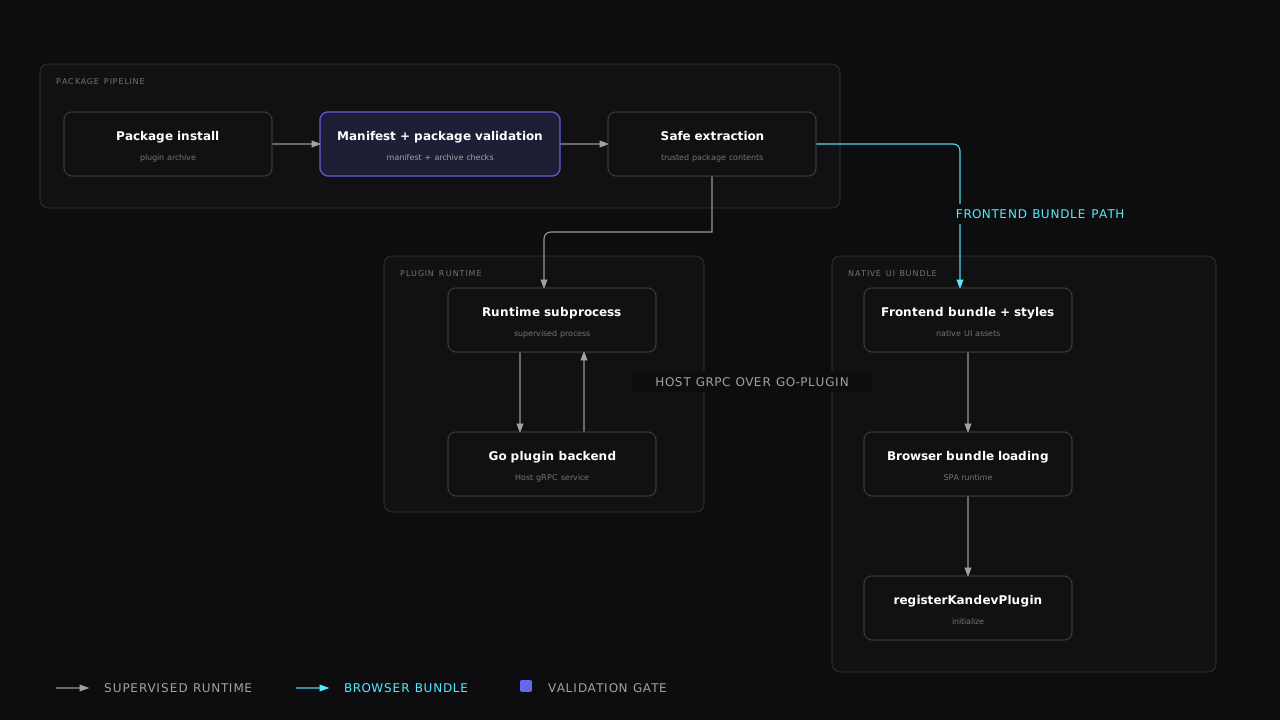

The two lower paths are intentionally separate: the Go subprocess uses the
host gRPC connection, while the browser receives static bundle assets and then
calls registerKandevPlugin.
Installation validates the manifest, archive paths, checksums, managed runtime,
and the current host executable before extraction. Kandev then supervises the
declared subprocess and injects a Host connection. Installing a new version
does not remove the one it replaces: that version stays on disk as the rollback
target, and only the versions before it are deleted, once the new one is
confirmed running. Two extracted versions is therefore the steady state for a
plugin that runs; a plugin that is disabled or failed to start keeps every
version it has, and data/ is never part of that cleanup. The UI bundle is static
package content loaded by the browser; it does not run inside the backend
subprocess. On disable or uninstall, the host calls destroy when present and
bulk-revokes registrations, styles, routes, handlers, and navigation. Reloads and
updates are generation-safe: a slow or failed initialization is not treated as a
definitive revocation, while a successfully ready generation can remove panels it
no longer registers. Each attempted generation owns its requests, subscriptions,
modals, task-link dialogs, toasts, and review surfaces. Timeout, failure, reload,
disable, or uninstall aborts and cleans those resources before calling destroy
exactly once; late callbacks from an expired generation are fenced from host state.
Package and data layout
<id>-<version>.tar.gz
├── manifest.yaml                         # required, validated first
├── server/
│   └── plugin-<goos>-<goarch>[.exe]      # one or more declared binaries
├── ui/
│   ├── bundle.js                          # optional native ES module
│   ├── plugin.css                         # optional styles
│   └── assets/                            # optional files referenced by UI
├── assets/                                # optional manifest icon/assets
├── checksums.txt                          # generated by plugin-pack
└── checksums.txt.sig                      # optional signature
runtime.executables maps a platform key such as linux-amd64 to a clean
package-relative path such as server/plugin-linux-amd64. Windows values must
end in .exe. The host platform's key must be present at install time.
A UI-focused native plugin still ships a managed backend executable because the
current installer requires runtime.type: binary. That executable can be a
no-op pluginsdk.UnimplementedPlugin server.
An isolated web-app package can omit runtime. It contains a static entry
document and the files that document imports. Use the ui.web_apps fields in
the manifest reference.
Kandev injects KANDEV_PLUGIN_DATA_DIR into the subprocess. It is the durable, per-plugin directory for arbitrary files or a plugin-owned database:
~/.kandev/plugins/<id>/data/The directory is shared across installed versions, survives restarts and upgrades, and is removed on uninstall. Keep small structured values in Host state instead, and never write arbitrary files elsewhere in the Kandev data directory.
Choose a plugin shape
| Shape | Package contents | Typical contract | Minimal capability set |
|---|---|---|---|
| Backend plugin | Go binary and manifest | events, webhooks, Host data, state, secrets, or utility-agent calls | only the capabilities used by the backend |
| UI-focused plugin | no-op managed binary, ui/bundle.js, optional styles/assets | routes, nav, named slots, WebSocket handlers, keybindings, shared store | ui.bundle; add ui.keybindings when declaring shortcuts |
| Combined plugin | Go binary plus UI bundle | UI calls a declared webhook or backend API; backend uses Host | union of the two surfaces, kept least-privilege |
| Isolated web app | manifest plus static HTML, CSS, JS, and assets | task or workspace canvas inside a sandboxed iframe | only the Kandev data, event, state, and network access it needs |
Build an isolated web application
Use this shape for a canvas app that runs packaged browser code. The package does not need a Go backend or an injected Kandev JavaScript API.
- Add one or more
ui.web_appsentries with a package-relative HTML entry. - Set
placementstotask-canvas,workspace-canvas, or both. - Build the app with relative
./_kandev/v1requests. - Declare only the Kandev capabilities and exact HTTPS
network_originsthat the app needs. - Package the manifest and static files as a gzip-compressed tar archive.
For a new owner-created task canvas, the first valid release can receive the
declared supported task-scoped permissions through its initial permission
policy. Imported packages and later permission increases need human approval.
Keep network_origins as exact HTTPS origins. Do not use wildcards, paths,
credentials, query strings, or fragments.
For example, a page can read task data with the browser Fetch API:
const response = await fetch("./_kandev/v1/data/tasks");
if (!response.ok) {
  throw new Error("The task data request failed");
}
const tasks = await response.json();
Use ./_kandev/v1/events for the event stream. Keep all protocol paths
relative so the same package works in task and workspace scope. Do not copy a
capability URL from the host into the app.
Kandev injects a reserved startup bootstrap into the packaged entry document.
It runs before authored scripts, reports an initial document error when one is
observed, and checks ./_kandev/v1/context after the document loads. The host
reveals the frame only after it receives a versioned acknowledgement for the
current startup attempt. A missing acknowledgement or context failure makes
the canvas recoverable after 15 seconds. Keep the entry document and its
relative assets valid HTML, and make the app render its own loading and error
states after startup.
The frame is same-origin with Kandev and canvas code is trusted with the
viewing user's ordinary user-session authority. It can use localStorage,
sessionStorage, IndexedDB, same-origin cookies, and the host DOM. Keep
Kandev protocol requests relative and do not copy capability URLs or tokens.
Use the state protocol for small app-specific shared values and JavaScript
memory for temporary values. Capability URLs, release bindings, scope checks,
and declared grants still govern every Kandev protocol operation.
Network access uses exact HTTPS origins that a user approves. Wildcards, origin paths, query strings, credentials, and remote scripts are not allowed. Keep scripts, styles, fonts, and images in the package.
Forms cannot submit to external origins. The runtime sets form-action 'none'.
External requests to approved origins are sent directly by the browser. Kandev
cannot inspect them after they leave the browser, so a release, grant, scope,
archive, disable, or removal notification immediately tears down the matching
iframe. A replacement iframe gets a fresh runtime binding.
The validator rejects unsafe paths and unsupported files. It also limits a package to 10 MiB compressed, 25 MiB expanded, 512 files, and 5 MiB per file. The manifest limit is 64 KiB and the normalized path limit is 240 bytes.
Build and test the archive outside Kandev. Kandev validates the archive before it stores or runs a release. Use Agent-authored Canvases for creation, permission review, promotion, Quick Chat editing, and recovery.
Share a portable canvas
For a canvas that another workspace can install, add the distribution block
described in the manifest reference.
Choose static when the packaged application is the only source you want to
share. Choose project when you retain a bounded editable project under
distribution/source/. Do not put screenshots in the package.
After a valid release is active, use Share canvas in the host or workspace canvas list. Prepare and download the bundle and source archive, inspect them for private content, and share them as files or HTTPS links. This action does not create a repository, release, registry entry, or pull request.
To list the canvas, publish the exact bundle as a versioned release asset and
add a kind: canvas entry with one to eight ordered previews objects to a
trusted registry. The first preview is the cover. Preview URLs and alt text
are registry metadata and are not part of the package manifest.
There is no separate HTTP server to launch. pluginsdk.Serve owns the go-plugin/gRPC handshake and Host injection. The backend implements pluginsdk.Plugin (OnEvent and/or HandleWebhook) and embeds pluginsdk.UnimplementedPlugin for no-op defaults.
Contribute an agent tool
A managed plugin can contribute task-aware MCP tools through the same supervised
gRPC process. Add an agent_tools declaration to manifest.yaml and implement
the optional pluginsdk.AgentToolPlugin interface:
agent_tools:
  - name: add_tag
    description: Add an existing tag to the current task.
    surfaces: [kanban-task]
    input_schema:
      type: object
      properties:
        tag_id: { type: string }
      required: [tag_id]
      additionalProperties: false
    annotations:
      read_only_hint: false
      destructive_hint: false
      idempotent_hint: true
The host exposes the readable canonical name
kandev_<plugin-id-slug>_<local-name> (for example,
kandev_task_tags_v1_add_tag). Punctuation in the stable plugin ID becomes an
underscore. Very long names receive a short stable hash suffix after the slug
is truncated. Tool names are host-owned; the plugin-local name is used for
the gRPC dispatch.
Tools may target kanban-task, office-task, or both. They are not exposed to
configuration or external MCP clients. Kandev validates the input and optional
output JSON Schemas, supplies task/session/workspace/surface context, enforces
a 30-second deadline and 1 MiB result limit, and does not retry calls.
The optional SDK method is:
InvokeAgentTool(context.Context, *pluginsdk.AgentToolRequest) (*pluginsdk.AgentToolResult, error)The request includes immutable invocation, task, session, workspace, and
surface context. Return required fallback text, optional structured content,
and IsError when the operation failed. Declaring a tool does not grant Host
API capabilities; use the existing capabilities fields for those permissions.
Security and capabilities
Plugins are privileged installed code. The capability list gates Host RPCs; it is not an operating-system sandbox. A backend subprocess inherits the Kandev process environment, and a UI bundle runs as same-origin JavaScript with the curated React, UI, and app-store surface.
- Plugins do not receive direct database access. Use typed Host readers/writers, Host state, secrets, events, and the data directory. Do not import Kandev internal/... packages or call undocumented REST endpoints.
- state gates Host state; secrets gates RevealSecret and plugin-owned secret methods; each api_read resource gates its reader; api_write gates task/message mutations and interaction responses; agent_invoke gates utility-agent calls; and capabilities.events controls event delivery.
- GetConfig and EmitEvent are ungated. GetConfig returns this plugin's own config, including cleartext secret fields, so do not log or commit it.
- Declared webhook keys default to public. Set
webhooks[].access: authenticatedfor browser UI and billable operations. Kandev does not enforcewebhooks[].method; public integrations must still validate the provider signature and replay/timestamp rules before side effects. - An authenticated webhook is reachable from your panel with any method,
GETincluded:host.api.fetchis same-origin (or carries an acceptedOriginin a split-origin install), which is what the host checks. You do not need to force a read ontoPOST. - capabilities.auth is the highest-risk capability. A webhook response may assert a verified external identity with X-Kandev-Auth-Login; only assert an email the IdP verified as owned by the subject. See ADR 0050.
- Plugin installations also carry a host-minted opaque installation identity and a generic capability-approval ledger. That ledger records approval history, exact approval revisions, and revocation tombstones for the host boundary, but there is no public mutation UI in this release. Future exact Host adapters consume the approval receipt/query surface; they do not derive authority from plugin IDs, package digests, or workspace state.
An isolated web app has a separate iframe and sandbox boundary. Kandev loads it same-origin with the host, so its trusted source can use the viewing user's ordinary browser authority, including cookies, storage, and the host DOM. It still cannot open popups or navigate the top-level page, and it receives no global Kandev JavaScript API. Capability URLs and grants remain required for Kandev protocol operations. See Security and trust for the runtime boundary.
Storage decision table
| Need | Use | Scope/lifecycle | Capability or rule |
|---|---|---|---|
| Small JSON object owned by this plugin | Host state: GetState, SetState, DeleteState, ListState | instance, workspace, task, or agent; survives restart/upgrade and is included in Kandev state backups | capabilities.state: true; values are JSON objects, not bare scalars |
| Canvas app shared state | Relative ./_kandev/v1/state protocol | Canvas instance; survives restart while the instance remains | state grant, store app-specific shared values, not duplicate task data |
| Per-user browser/plugin storage | host.storage: get/set/delete/list/subscribe | instance, workspace, task, session, or repository, scoped per user | capabilities.user_state: true; set/delete accept ifUnmodifiedSince and writerId |
| Temporary canvas app value | JavaScript memory inside the iframe | Current document only | Use browser storage for user-scoped client data; keep shared app values in canvas state |
| Operator configuration | Host.GetConfig and manifest config_schema | Plugin-owned settings; config changes restart an active subprocess | Ungated GetConfig; secret fields arrive cleartext in the subprocess |
| Plugin-owned credentials | Host.GetSecret/SetSecret/DeleteSecret, or secret: true config fields | Encrypted Kandev vault, namespaced to this plugin | capabilities.secrets: true; never log values |
| Files, caches, or plugin-managed database | KANDEV_PLUGIN_DATA_DIR | Shared across versions, removed on uninstall | Write only below the injected directory; own schema, locking, and migrations |
Host state is not host.storage: Host state is plugin-scoped backend state with no transaction primitive, so design updates to be idempotent; host.storage (below) is per-user, per-scope frontend storage with an optional ifUnmodifiedSince compare-and-swap.
host.storage belongs to the native plugin frontend contract. An isolated web
app does not receive that API. Use the canvas state protocol instead.
Authoritative contracts
The guide summarizes the contract for discovery. These files remain the source of truth and must be updated together when the contract changes:
- Versioned frontend author contract:
@kandev/plugin-sdk, sourced fromapps/packages/plugin-sdk. Import it withimport type; the package has no dependency on Kandev, React, Zustand, or private@/modules, so it also typechecks when consumed from an isolated or sparse checkout. - Frontend host implementation: docs/plans/plugins/PLUGIN-API.md and apps/web/lib/plugins/types.ts. These may contain compatibility-only host details that are deliberately absent from the public SDK.
- Concrete frontend Host exports: apps/web/lib/plugins/host-api.ts.
- Backend author API: apps/backend/pkg/pluginsdk.
- Wire contract: apps/backend/proto/kandev/plugin/v1/plugin.proto.
- Manifest model and semantic validation: apps/backend/internal/plugins/manifest.
- Package integrity and installation: apps/backend/internal/plugins/pkgtar.
- Durable decisions: ADR 0043, ADR 0047, ADR 0048, ADR 0050, explicit plugin utility selection, and Browser conversation facade ADR.
The source reconciliation design
defines the current storage and transport behavior. Requirements define
observable behavior, and PLUGIN-API.md defines the browser API and Host-only
v2 wire contract.
Frontend contract
Loading and cleanup
The package's ui.bundle is a hand-written ES module. When active, Kandev loads it and the bundle calls:
window.registerKandevPlugin("my-plugin", {
  initialize(registry, host) {},
  destroy() {},
});
initialize receives a registry scoped to this plugin and a PluginHostApi. The host may call initialize more than once across disable/enable cycles. Make it repeatable; return a cleanup function from subscriptions and timers, and use destroy to remove side effects that are not registrations. The host revokes all registry entries, closes plugin modals, and removes plugin styles on disable/uninstall. Reloads can temporarily leave a plugin in a loading or failed state; open and saved panels remain until the current generation is ready. A ready generation that no longer registers a panel closes it, while an explicit disable or uninstall closes every panel owned by the plugin. This lifecycle bookkeeping is host-internal; plugins do not call lifecycle methods.
Type frontend bundles against the versioned, runtime-free SDK rather than copying host interfaces or importing Kandev application files:
import type { PluginHostApi, PluginRegistry } from "@kandev/plugin-sdk";Official code-host plugins use host.context for provider-neutral workspace,
task-creation, and exact repository-identity reads. getWorkspaceIds() and
subscribeWorkspaces() let a plugin republish workspace-scoped integration
state after load or when the workspace list changes. If a required read is
missing, extend this typed context contract; do not reverse-engineer Zustand
slice shapes in a released plugin.
Users configure a plugin's declared shortcuts on that installed plugin's detail
page at Settings > Plugins > <plugin>. These overrides are personal to
the signed-in user. The plugin's schema-driven configuration and lifecycle
controls remain install-wide and administrator-only.
If a bundle registers a component at its exact plugin detail route, Kandev keeps that component and renders the host-owned shortcut card alongside it. Nested plugin settings routes remain fully plugin-owned.
Browser conversation facade
Native UI plugins read prompt history through host.conversation, not through
host.store, raw WebSocket frames, first-party /api/v1 URLs, or the Go Host
reader. The facade requires capabilities.api_read: ["messages"], and every
manifest declaring that capability requires min_kandev_version: "0.91.1" or
later. The same floor applies to Go host.Messages().List plugins. It returns
sanitized public SDK DTOs. Inside a task panel, prefer the injected
conversation.history handle so the read stays bound to that panel's task,
session, and plugin generation:
function PromptHistory({ sessionId, conversation }: PluginTaskPanelProps) {
  const { messages, loading, loadMore } =
    conversation.history.useSessionMessages({ sessionId });
  return <PromptList messages={messages} loading={loading} onLoadMore={loadMore} />;
Panel handles are independently scoped and become inert on unmount, identity
change, disable, or reload. host.conversation is the equivalent nearest-scope
accessor; outside a panel it returns stable empty state. Use the canonical
PLUGIN-API contract for DTOs, pagination,
revision-bound updates, lifecycle, recovery, and retryable errors. A complete
source mutation sends a transient revision receipt after commit. An incomplete
or uninstrumented mutation sends a reset marker, and the Host reads current
source rows to repair the panel. The transport does not retain a payload
journal or provide a replay guarantee.
Browser route errors use unauthenticated/non-retryable for 401,
not_found/non-retryable for 404, invalid_query/non-retryable for 400,
and upstream_failure/retryable for every authorized 5xx.
Within a task panel, omitted taskId inherits the panel task, explicit
null reads the whole selected session, and an explicit task ID must match the
panel task. loadMore() resolves to the number of newly projected messages;
joined, exhausted, closed, and removed calls are deterministic, while
transport failures reject with the typed error and preserve committed state.
The turns hook follows the same scope and lifecycle rules, favorites remain
read-only and reactive, and session.removed retains visible rows while
closing future reads.
| Need | Browser facade | Go Host API |
|---|---|---|
| Surface | host.conversation or conversation.history | host.Messages().List |
| Runtime | Native UI bundle | Plugin server process |
| Data | Sanitized browser DTOs and revision-bound updates | Typed paginated reader |
| Forbidden shortcut | host.store, raw WS, /api/v1 | Private application imports |
Frontend hook/API matrix
| Surface | Location and input | Manifest requirement | Cleanup/lifecycle | Small example |
|---|---|---|---|---|
| registerRoute | registry.registerRoute(path, Component, options?); exact SPA path; options.topbar defaults to host chrome or false for full-bleed | Active ui.bundle | Route is removed on disable/uninstall; use destroy for subscriptions | registry.registerRoute("/acme", Page, { topbar: { title: "Acme" } }) |
| registerNavItem | { id, label, path, icon?, section? }; section is main, integrations, sidebar-footer (sidebar footer icon row, subject to an inline budget past which the item moves to the footer's overflow menu; and phone menu Utilities group, uncapped), or accepted-but-not-rendered settings | Active ui.bundle | Nav item is revoked and removed from desktop/phone navigation | registry.registerNavItem({ id: "home", label: "Acme", path: "/acme", icon: "chart" }) |
| registerSettingsRoute | registerSettingsRoute(fullPath, Component) with an exact path under /settings/plugins//...; settings shell supplies chrome | Active ui.bundle | Route is removed on disable/uninstall | registry.registerSettingsRoute("/settings/plugins/acme/health", HealthPage) |
| registerComponent | registerComponent(slot, Component); component receives { slotProps?: unknown } | Active ui.bundle | Every registration is owner-tracked, error-isolated, and bulk-revoked | registry.registerComponent("task-sidebar", Panel) |
| registerWsHandler | registerWsHandler(action, handler(payload)); receives actions bridged from lib/ws | Active ui.bundle | Handler is removed on disable/uninstall; tolerate duplicate/replayed actions | registry.registerWsHandler("acme.updated", renderUpdate) |
| registerKeybinding | registerKeybinding(id, handler(event)); id must be declared in ui.keybindings; users can override the effective combo on the installed plugin detail page at Settings > Plugins > <plugin> | ui.bundle and ui.keybindings[] | Handler is removed on disable/uninstall; core shortcuts win, and editable targets are skipped unless that entry set ui.keybindings[].allow_in_editor | registry.registerKeybinding("open-panel", () => host.openModal(...)) |
| registerIntegrationSettings | One provider-owned settings component with an optional action mounted in the detail header and the integrations index card | Active ui.bundle | Registration is exclusive by id and revoked on unload; host owns workspace selection and settings navigation; component and action receive the routed workspaceId, and action receives its surface | registry.registerIntegrationSettings({ id: "acme", Component, action: Toggle }) |
| registerTranslations | Flat English fallback plus optional Kandev locale catalogs, isolated to this plugin's namespace | Active ui.bundle | Catalogs are replaced atomically, removed on unload, and registry consumers invalidate when the host locale changes | registry.registerTranslations({ en: { settings: "Settings" }, "pt-pt": { settings: "Definições" } }) |
| registerRepositoryProvider | Provider-owned paged/searchable repository list, URL match/inspect, branches, and optional native createChangeRequest transport | ui.bundle and matching repository_providers[] id | Registration and in-flight callbacks are result-fenced on unload; host owns native task and Create PR UI | registry.registerRepositoryProvider({ id: "acme", ...provider }) |
| registerTaskAction | Child action inside the task menu's native Link section | Active ui.bundle | Action is revoked on unload; host supplies current task/workspace and desktop/mobile presentation | registry.registerTaskAction({ id: "link-pr", placement: "link", ... }) |
| registerReviewProvider | Normalized task reviews, workspace associations, unlink, and shared Review panel | ui.bundle and matching repository_providers[] id | Snapshots/subscriptions are owner-scoped and revoked on unload; host owns status chrome, indicators, unlink UI, and responsive Review placement | registry.registerReviewProvider({ id: "acme", ...reviews }) |
| registerTaskPanel | { id, title, titleKey?, icon?, Component, mobileEnabled?, visible?(context) }; adds a row to the task workspace's "+" (add panel) menu; Component receives { panelId, taskId, sessionId, sessionKind, presentation, conversation: { openMessage(messageId), history } }; titleKey is a plugin translation key with literal title fallback | Active ui.bundle | Panel renders behind its own error boundary with reactive localized titles; a throwing visible hides the item; handles are generation-bound and independently scoped, inert after unmount, identity change, disable, reload, or uninstall; host.conversation outside a panel returns stable empty state; desktop preserves layout identity on navigation and mobile uses the full-height Chat surface | registry.registerTaskPanel({ id: "notes", title: "Notes", titleKey: "panels.notes", Component: NotesPanel }) |
| registerTaskMenuAction | { id, label, icon?, group: "edit" | "primary", visible?(context), run(context) }; "edit" is card-only inside Edit, while "primary" is a flat item on cards and desktop/mobile task-row menus | Active ui.bundle | Action is revoked on disable/uninstall; a throwing/rejecting run is caught and logged | registry.registerTaskMenuAction({ id: "enhance", label: "Enhance", group: "primary", run: doEnhance }) |
| registerTaskFilter | { id, label, getOptions(), matches(context, selected) }; adds a client-side, multi-select filter section to the kanban board's display dropdown, alongside Workflow/Repository | Active ui.bundle | Filter is revoked on disable/uninstall; selections are ephemeral (not persisted); matches is only called for a non-empty selection, and a throw is caught, logged, and treated as non-matching | registry.registerTaskFilter({ id: "tags", label: "Tags", getOptions: listTagOptions, matches: taskHasSelectedTag }) |
| registerTaskListFacet | { id, label, getValues({ taskId, workspaceId }), subscribe? }; adds page-local Sort and Group choices on /tasks | Active ui.bundle | Values apply only to the loaded page, callbacks are isolated, and registrations are revoked on disable/unload | registry.registerTaskListFacet({ id: "tags", label: "Tag", getValues: taskTags }) |
| host.React / host.jsx | Shared React instance and React.createElement alias | Active ui.bundle | No cleanup; never bundle a second React/Radix runtime | const h = host.jsx |
| host.context | Versioned provider-neutral reads/subscriptions for active workspace, all workspace ids, native task creation, and exact provider repository identity | Active ui.bundle | Subscriptions are generation-owned and revoked on unload; records are stable SDK shapes, not private app state | const ids = host.context.getWorkspaceIds() |
| host.useSettingsSaveContributor | Registers one plugin-owned contributor for the native save bar; the host prefixes ids with plugin:<pluginId>: before shared coordination | Active ui.bundle | Contributor lifecycle follows the rendering component; save and discard remain plugin-owned | host.useSettingsSaveContributor({ id: "credentials", revision, isDirty, save, discard }) |
| host.setIntegrationEnabled | Publishes one registration's live enabled value for one workspace; the value is reactive but not durable | Active ui.bundle | The host validates that integrationId belongs to this plugin; republish after load using host.context.getWorkspaceIds() and subscribeWorkspaces() | host.setIntegrationEnabled("acme", workspaceId, enabled) |
| host.i18n | Plugin-scoped locale, imperative t(key, options?), and reactive useTranslation() | A registered English catalog | Locale changes re-render reactive consumers; missing active-locale messages fall back to the plugin's English catalog | const { t } = host.i18n.useTranslation(); t("pullRequests") |
| host.store (legacy) | Compatibility-only access to Kandev's private Zustand store; intentionally absent from @kandev/plugin-sdk | Older ui.bundle | Do not use in new or official plugins; private slices may change without plugin-API compatibility | Migrate reads to host.context |
| host.api.fetch / baseUrl | fetch(path, init?) is scoped to /api/plugins//...; baseUrl is the backend origin for split-origin deployments | Active ui.bundle; backend path must be a declared webhook when relayed | Declare webhooks[].access: authenticated for UI-only or billable operations; requests are generation-aborted on unload | host.api.fetch("webhooks/inbound", { method: "POST" }) |
| host.api.invokeAction | Authenticated call to a declared action with host-verified workspace/task/session/repository selectors and bounded untrusted body | Matching manifest actions[] key/scope | Browser abort cancels the bounded plugin RPC; safe domain statuses and Retry-After may be returned | host.api.invokeAction("reviews.get", { taskId }, { signal }) |
| host.storage | Authenticated, per-user key/value storage: get(scope, scopeId, key, options?)/set(scope, scopeId, key, value, options?)/delete(scope, scopeId, key, options?)/list(scope, scopeId, options?) plus subscribe(filter, handler); no plugin backend required | capabilities.user_state: true | Reads and writes accept an AbortSignal; set/delete also accept writerId (appended to the host's per-tab id, not a replacement) for echo suppression; list returns every entry under the scope pair, unpaginated | host.storage.set("task", taskId, "note", value, { writerId: panelId, signal }) |
| host.ui | Curated host instances: Alert*, Badge, Button, Card*, Checkbox, Dialog*, DropdownMenu*, Input, Label, Pagination*, ScrollArea, Select*, Separator, Sheet*, Skeleton, Spinner, Switch, Table*, Tabs*, Textarea, Tooltip*, RichTextEditor, RichTextReadOnly, plus Combobox, PageTopbar, TaskCreateDialog | Active ui.bundle | Host owns contexts/portals; render with host React and let modal/slot cleanup run | const Button = host.ui.Button |
| host.theme | Current "light" or "dark" theme | Active ui.bundle | Read during render; subscribe through host/app patterns if theme-sensitive | host.theme === "dark" |
| host.navigate | Soft SPA navigation navigate(href, { replace? }) | Active ui.bundle | No registry cleanup; avoid navigating to undeclared external origins | host.navigate("/t/" + taskId) |
| host.openModal | Host-owned modal: { title?, content, size?, dismissible? } -> { close() } | Active ui.bundle | Modal auto-closes on disable/uninstall; close handles are idempotent | const modal = host.openModal({ content: Panel }) |
Code-host integration surface map
A code-host plugin should be a normalized provider adapter, not a parallel copy of Kandev's GitHub UI. The plugin owns remote API calls, authentication, provider identifiers, and normalized snapshots. Kandev owns the interaction patterns, responsive layout, status colors, dialogs, menus, and review chrome.
| User-facing result | Plugin hook | Plugin supplies | Kandev supplies |
|---|---|---|---|
| Provider workbench | registerRoute, registerNavItem, and host dashboard primitives | Query state, normalized rows, opaque cursors, refresh and launch callbacks | Page chrome, searchable repository filter, cursor pagination, saved-query dialog, list rows, task preset menu, desktop/mobile primitives |
| Workspace connection settings | registerIntegrationSettings | Provider-specific fields, health checks, connect/disconnect behavior | Settings navigation, active workspace, lifecycle and error boundary |
| Native repository and branch selection | registerRepositoryProvider plus declared branch action | Credential-free repositories, branches, URL inspection, optional createChangeRequest transport | Existing task dialog, provider picker, branch picker, push-before-create flow |
| Task-to-review linking | registerTaskAction and host.openTaskLinkDialog | Provider label/icon, accepted reference syntax, authenticated link callback | Existing Link submenu, dialog validation, submit state, toast and desktop/mobile presentation |
| Task indicators, CI, unlink and review | registerReviewProvider | Association snapshots, semantic taskStatus, normalized review detail, refresh/unlink callbacks | Sidebar/Kanban indicators, status palette, 90-second refresh, topbar/composer status, unlink UI and shared Review panel |
Composer # search | Manifest reference_sources, SearchEntityReferences, and AuthorizeEntityReference | Display candidates and a fresh provider authorization at submission | Source menu, chips, canonical metadata and fail-closed submission |
| Authenticated browser operations | Manifest actions and host.api.invokeAction | Bounded action handler using verified context | Actor/resource authorization, selector stripping, timeout, cancellation and response limits |
The task indicator uses the same semantic precedence as first-party providers: failures and requested changes are red, pending checks yellow, an outstanding review with passing checks sky blue, passing checks green, merged reviews purple, and neutral or draft reviews muted. Publish semantic state only; never send CSS classes or provider-selected colors.
Persist links, suppressions, task reservations, and watches by provider ID, provider connection scope, immutable repository ID, and change-request number. Repository names, paths, clone URLs, and human-readable review keys can change or be reused, so use them only for display and live lookup. Bind watch state and OAuth refresh work to an opaque connection epoch; replacement or disconnect must fence in-flight results, while an explicit resume may bind a watch to the new epoch.
Keep refresh(taskId) lightweight: publish metadata, reviewers, checks, and an
inexpensive comment count when available. Load files, diffs, commits, and comment
bodies from ReviewPanel only when the user opens Review. Bound every provider page
and action response, and expose truncation rather than overflowing Kandev's response
limit.
Repository listing callbacks receive optional query, opaque cursor, limit, and
signal fields. Return { repositories, nextCursor } for a page; returning an array
remains compatible for small or older providers. Treat cursors as provider-owned opaque
values, bind them to the original query, and stop emitting nextCursor when exhausted.
Include immutable repository identity and provider connection scope in that binding;
reject a mismatched cursor before making a remote request.
Kandev follows pages and fails a repeated cursor instead of looping forever.
Localize plugin UI
Register an English fallback before registering labels or rendering routes.
Catalogs are flat, plugin-scoped, and support {{name}} interpolation plus
_one/_other plural keys. Use the reactive hook in components and the
imperative translator in registry getters so a locale change updates native
navigation and provider labels without reloading the plugin.
registry.registerTranslations({
  en: {
    pullRequests: "Pull requests",
    linkedCount_one: "{{count}} pull request linked",
    linkedCount_other: "{{count}} pull requests linked",
  },
  "pt-pt": {
    pullRequests: "Pull requests",
    linkedCount_one: "{{count}} pull request associado",
    linkedCount_other: "{{count}} pull requests associados",
  },
});

const translate = host.i18n.t;
registry.registerNavItem({
  id: "reviews",
  get label() {
    return translate("pullRequests");
  },
  path: "/reviews",
});

function ReviewsPage() {
  const { t } = host.i18n.useTranslation();
  return host.jsx("h1", null, t("pullRequests"));
}
Own provider brand icons
Icon fields accept a curated host icon name or a plugin-owned component. Keep
provider brands in the plugin repository so a new code host does not require a
Kandev icon-map change. Build the component with host.jsx; do not bundle React.
const AcmeIcon = ({ className }: { className?: string }) =>
  host.jsx(
    "svg",
    { viewBox: "0 0 24 24", className, "aria-hidden": true },
    host.jsx("path", { d: "M4 12h16" }),
  );

registry.registerRepositoryProvider({
  id: "acme",
  label: "Acme",
  icon: AcmeIcon,
  // listRepositories, listBranches, and inspectURL omitted here
});
Kandev accepts only supported host locale IDs, at most 1,000 messages per locale, safe flat keys, and messages up to 4,096 characters. An invalid replacement is rejected before the active catalog changes. Do not translate provider identifiers, action keys, URL paths, or other machine-readable state.
For a plugin-owned workbench, use host.ui.IntegrationRepositoryFilter and
host.ui.IntegrationCursorPagination; they preserve the same searchable picker,
pagination geometry, touch targets, and responsive behavior as first-party code-host
pages without requiring a plugin to copy their markup.
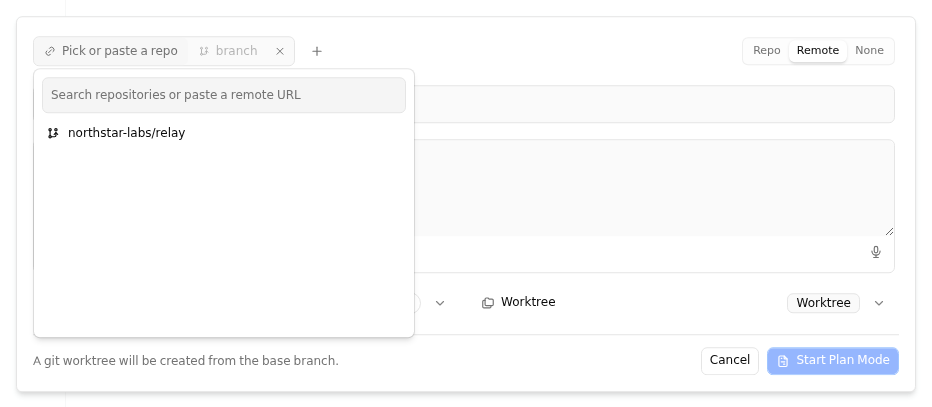
The examples below were captured from an isolated packaged-plugin run. The provider data is fictional; the surrounding controls are the production host-owned components.
Provider dashboard and repository picker
The plugin route composes the shared dashboard primitives, while the declared repository provider appears inside Kandev's existing task dialog.

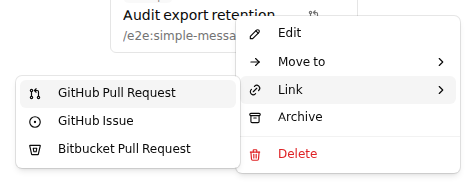
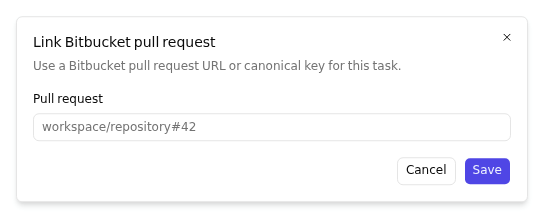
Link a pull request from a task
registerTaskAction contributes only the provider entry. The host owns the
parent Link menu and the link dialog.
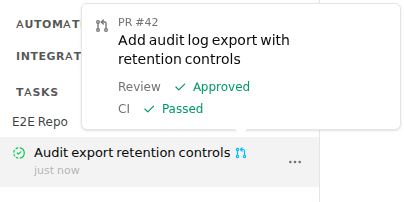
Task status, CI, and review
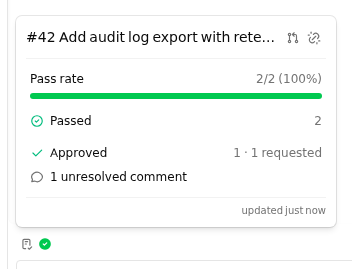
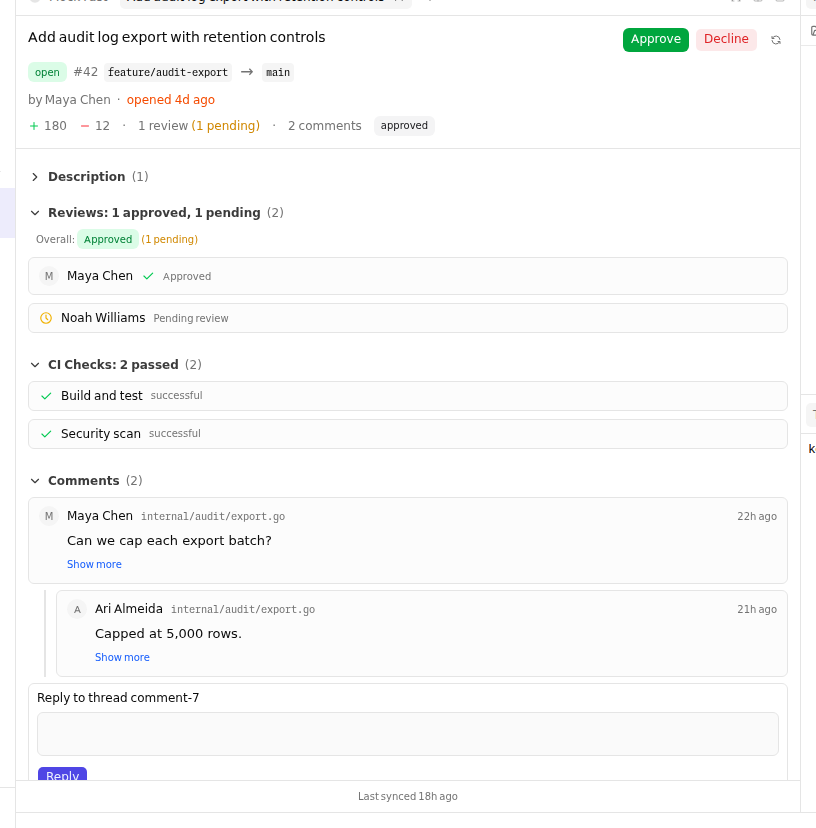
Association and review snapshots drive every surface. In this example, passing CI plus one outstanding reviewer makes the task icon sky blue; hovering it shows the same normalized summary used by first-party providers.
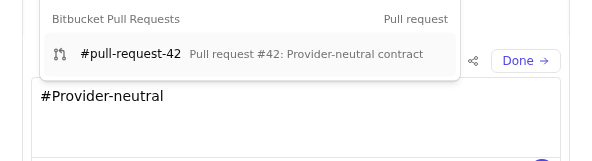
Composer reference search
Dynamic reference_sources appear beside built-in sources. A selected result is
display-only until Kandev calls the plugin again to authorize it for submission.
Supported named slots
registerComponent currently has these mounted slots. The source type is open to strings, but an unmounted name renders nowhere.
| Slot | Mounted location | slotProps |
|---|---|---|
| task-sidebar | Bottom of task-detail sidebar | none |
| settings-nav | Settings navigation tree | none |
| chat-input-actions | Task or Quick Chat composer toolbar | PluginComposerSlotProps |
| task-create-input-actions | Task creation composer toolbar | PluginComposerSlotProps |
| new-session-input-actions | New-session composer toolbar | PluginComposerSlotProps |
| chat-submit-decoration | Layer over the composer's send button | ChatSubmitDecorationSlotProps |
| chat-top-bar | Session top bar | { taskId, taskTitle?, workspaceId, activeSessionId, sessionIds } |
| main-top-bar | Home/Kanban/Tasks top bar | { workspaceId, workspaceLabel?, currentPage } |
| app-status-bar-left | Left side of desktop status bar or mobile status drawer | AppStatusBarSlotProps |
| app-status-bar-right | Right side of desktop status bar or mobile status drawer | AppStatusBarSlotProps |
| plugin-settings | Top of this plugin's Settings > Plugins page | { pluginId, status }; owner-scoped to the plugin being viewed |
| task-card-indicators | Kanban card, beside the PR status icon | { taskId, workspaceId, workflowStepId } |
| task-card-tags | Kanban card, its own row below the badges row | { taskId, workspaceId, workflowStepId } |
| task-row-metadata | Sidebar task tree and /tasks rows | TaskRowMetadataSlotProps |
| sidebar-workspace-actions | Desktop New Task row or phone navigation action group, after Quick Terminal and Quick Chat | SidebarWorkspaceActionsSlotProps |
AppStatusBarSlotProps is { placement, presentation, density, pathname, activeWorkspaceId, activeTaskId, activeSessionId }. Desktop presentation is a compact 24px bar; mobile presentation is an in-flow drawer, so render a touch-usable row. Status items can be reordered by the host; plugins do not get an ordering API.
SidebarWorkspaceActionsSlotProps is { workspaceId, workspaceLabel?, presentation }. The host uses presentation: "desktop" for the compact
sidebar cluster and presentation: "mobile" for the phone navigation sheet.
Mobile actions must keep their own buttons or links at least 44px in the active
dimension and provide an accessible name.
PluginComposerSlotProps is { surface, presentation, taskId, taskTitle?, activeSessionId, sessionIds, disabled, submittable, disabledReason?, composer }.
The composer capability provides insertText, focus, and asynchronous
submit; submit returns submitted only when the native composer accepts the
operation, otherwise blocked or unavailable.
Backend contract
Plugin lifecycle surface
| Surface | Input/output | Manifest capability or declaration | Lifecycle/cleanup | Example |
|---|---|---|---|---|
| Plugin.OnEvent | OnEvent(ctx, *pluginsdk.Event) error; event has EventID, EventType, OccurredAt, WorkspaceID, Payload | Matching capabilities.events subject/pattern | Delivery is sequential per plugin with bounded queue and retries; make handlers idempotent by EventID and reconcile critical state | if event.EventType == "task.created" { ... } |
| Plugin.HandleWebhook | HandleWebhook(ctx, *pluginsdk.WebhookRequest) (*WebhookResponse, error); request includes key, method, path, query, headers, body | webhooks[].key; auth additionally required for login assertion header | Undeclared keys are 404; GET/POST are relayed; validate method/signature and bound side effects | if req.WebhookKey == "inbound" { ... } |
| Host.EmitEvent | EmitEvent(ctx, name, payload) publishes plugin.. | None; intentionally ungated | Subscribers must declare the emitted subject; use versioned names/payloads | host.EmitEvent(ctx, "sync.completed", payload-map) |
Event delivery is best-effort: Kandev makes the initial attempt plus retries with 5s, 15s, and 45s delays, and a bounded in-memory queue/error buffer can drop events during sustained overload or restart. Use EventID for deduplication and a source-of-truth reconciliation path when loss matters. The full subscription vocabulary and wildcard rules are in the manifest reference.
Host API matrix
| Host surface | Methods | Required manifest capability | Notes |
|---|---|---|---|
| State | GetState, SetState, DeleteState, ListState | state: true | Plugin-scoped JSON objects keyed by scope/scopeID/key; no transactions |
| Config | GetConfig | None | Reads this plugin's validated config_schema; secret fields are cleartext in the subprocess; config updates restart active plugins |
| Secrets | RevealSecret, GetSecret, SetSecret, DeleteSecret | secrets: true | Encrypted vault; plugin-owned keys are namespaced; never log values |
| Tasks | Tasks().List, Tasks().Get | api_read: tasks | Typed DTOs and opaque pagination cursor |
| Tasks writes | Tasks().Create, Tasks().Update, Tasks().Move | api_write: tasks | Implemented; routed through Kandev services so events/WS updates fire. Create and Update support priority. Update rejects a workflow step change; Move is the only path that moves a task between steps |
| Sessions | Sessions().List, Sessions().CodeStats | api_read: sessions | Typed session and computed code-stat records |
| Workspaces | Workspaces().List | api_read: workspaces | Instance-visible workspaces |
| Workflows | Workflows().List, Workflows().ListSteps | api_read: workflows | List steps by workflow id |
| Agent profiles | AgentProfiles().List | api_read: agent_profiles | Global agent profiles exposed by the Host data API |
| Repositories | Repositories().List | api_read: repositories | List by workspace id |
| Messages | Messages().List | api_read: messages | Historical user/agent content; Kandev system blocks are stripped |
| Message send | Messages().Send | api_write: messages | Sends a prompt to a task session and records plugin: author |
| Interactions | Interactions().ListPending, Interactions().Get | api_read: interactions | Durable record of agent requests still owed a human answer; Get resolves resolved ones too |
| Interaction responses | Interactions().RespondToPermission, .AnswerClarification, .CancelClarification | api_write: interactions | Routed through the services the native UI drives; first terminal response wins |
| Agent invocation | InvokeUtilityAgent(ctx, prompt, options...) | agent_invoke: true | One-shot completion. No options, or an empty ProfileID, uses the current platform default. A non-empty ProfileID selects that exact eligible profile. An invalid explicit profile returns FailedPrecondition without fallback. The host does not read plugin configuration for selection. |
| Agent conversations | AgentConversations(host): Ensure, Dispatch, Delete | agent_conversation: true | Hidden workflowless ephemeral task/session per plugin, workspace, and conversation key; dispatch occurrence keys are durable and idempotent; uninstall removes every conversation owned by the plugin |
The Go signatures, filters, DTOs, and pagination types live in apps/backend/pkg/pluginsdk/host.go and data_types.go. api_write task/message methods are implemented in the current branch; do not repeat older docs that call them reserved.
Host calls are request-scoped rather than registrations: pass the handler
context, handle cancellation, and close any files or external clients created
by the plugin. There is no Host cleanup callback. Typical calls are
host.SetState(ctx, "task", taskID, "note", value),
host.Tasks().List(ctx, filter, page),
host.Tasks().Create(ctx, pluginsdk.CreateTaskInput{...}),
host.Messages().Send(ctx, taskID, sessionID, text), and
host.InvokeUtilityAgent(ctx, prompt); each fails with PermissionDenied
when its manifest capability is absent.
Task-oriented recipes
The snippets below are deliberately small. Keep the full template Makefile and release workflow from the official scaffold.
The maintained in-tree fixture shows the same surfaces end to end: its Go backend, manifest, and native bundle are the source examples used by the package and browser tests.
1. UI-focused plugin
Use a no-op backend because the managed installer requires a host executable.
# manifest.yaml
id: "acme-dashboard"
api_version: 1
version: "0.1.0"
display_name: "Acme Dashboard"
runtime:
  type: binary
  executables:
    linux-amd64: server/plugin-linux-amd64
ui:
  bundle: "/ui/bundle.js"
// server/main.go
package main
import "github.com/kandev/kandev/pkg/pluginsdk"
func main() { pluginsdk.Serve(&pluginsdk.UnimplementedPlugin{}) }// ui/bundle.js
window.registerKandevPlugin("acme-dashboard", {
initialize(registry, host) {
function Page() {
return host.jsx("main", null, "Acme dashboard");
}
registry.registerRoute("/acme-dashboard", Page);
registry.registerNavItem({
id: "home",
label: "Acme",
path: "/acme-dashboard",
icon: "chart",
});
},
});2. Go backend with Host state
type Plugin interface {
	// OnEvent handles a single bus event delivery. A non-nil error causes
	// kandev to retry (3 retries, 5s/15s/45s backoff).
	OnEvent(ctx context.Context, e *Event) error

	// HandleWebhook handles an inbound request relayed from
	// POST /api/plugins/{id}/webhooks/{key}.
	HandleWebhook(ctx context.Context, req *WebhookRequest) (*WebhookResponse, error)
}
Embed pluginsdk.UnimplementedPlugin and override only the methods you need
It is a no-op base that also implements HostSetter, so Serve injects a
live Host into your plugin once the broker connection back to kandev is
established (retrieve it later via p.Host()).
Webhooks
Declare each webhook key in manifest.yaml. Kandev relays GET and POST
requests for /api/plugins/<id>/webhooks/<key> to HandleWebhook; undeclared
keys return 404. Request bodies are limited to 4 MiB and requests that
exceed the limit return 413 before reaching the plugin. Kandev does not
authenticate webhook callers or enforce the manifest's informational method,
so validate the HTTP method and the upstream provider's signature before any
side effect.
The Host API
A plugin calls back into kandev through the injected Host:
type UtilityAgentOptions struct {
	ProfileID string
}

type Host interface {
	GetState(ctx context.Context, scope, scopeID, key string) (value map[string]any, found bool, err error)
	SetState(ctx context.Context, scope, scopeID, key string, value map[string]any) error
	DeleteState(ctx context.Context, scope, scopeID, key string) error
	ListState(ctx context.Context, scope, scopeID string) ([]StateEntry, error)

	// GetConfig returns the plugin's own operator-editable config (set via
	// Settings > Plugins > <plugin>, generated from manifest config_schema).
	// Ungated: always readable, secret values included. Kandev restarts a
	// running plugin when its config changes, so re-read at startup.
	GetConfig(ctx context.Context) (map[string]any, error)

	// GetSecret/SetSecret/DeleteSecret manage a plugin-owned secret in
	// kandev's encrypted vault, namespaced to this plugin. Require the
	// `secrets` capability.
	GetSecret(ctx context.Context, key string) (value string, found bool, err error)
	SetSecret(ctx context.Context, key, value string) error
	DeleteSecret(ctx context.Context, key string) error

	// RevealSecret resolves an operator-provided secret reference (e.g. a
	// config value pointing at a shared kandev secret) to its cleartext
	// value. For secrets the plugin itself owns, use GetSecret/SetSecret.
	RevealSecret(ctx context.Context, ref string) (string, error)

	EmitEvent(ctx context.Context, name string, payload map[string]any) error

    // Tasks/Sessions/Workspaces/Workflows/AgentProfiles/Repositories return
	// Host data accessors. List/Get operations require their own api_read
	// resource; task Create/Update/Move require api_write:tasks.
	Tasks() TaskReader
	Sessions() SessionReader
	Workspaces() WorkspaceReader
	Workflows() WorkflowReader
	AgentProfiles() AgentProfileReader
	Repositories() RepositoryReader

	// Messages.List reads historical content (api_read:messages); Send
	// delivers a user prompt through the task session (api_write:messages).
	Messages() MessageReader

	// InvokeUtilityAgent runs a one-shot completion. No options uses the
	// platform default. UtilityAgentOptions.ProfileID selects one eligible
	// profile for this call (capability agent_invoke).
	InvokeUtilityAgent(ctx context.Context, prompt string, options ...UtilityAgentOptions) (string, error)
}
Executor profiles are an additive, optional Host extension so older Host implementations remain source-compatible. Discover it through the SDK helper:
profiles, ok := pluginsdk.ExecutorProfiles(host)
if ok {
	items, page, err := profiles.List(ctx, pluginsdk.Page{})
	// handle items, page, and err
}
Declare api_read: ["executor_profiles"] before using this reader. A host that
does not implement the extension returns ok == false; an implemented reader
without the capability returns PermissionDenied from List.
Pending agent interactions are an additive, optional Host extension too;
discover it the same way with pluginsdk.Interactions(host). See "Pending
agent interactions" below for the contract.
Managed agent conversations are another optional Host extension. They let a backend plugin keep one hidden agent session for each workspace and stable conversation key:
conversations, ok := pluginsdk.AgentConversations(host)
if !ok {
	return errors.New("this Kandev host does not support agent conversations")
}

descriptor, status, err := conversations.Ensure(ctx, pluginsdk.AgentConversationSpec{
	WorkspaceID:     workspaceID,
	ConversationKey: "coordinator",
	BasePrompt:      "Review this workspace and report actionable changes.",
	AgentProfileID:  configuredProfileID,
})
Declare agent_conversation: true before using the manager. Ensure returns
created, exists, or configuration_required; the last result creates no
task or session. Dispatch returns started, sent, duplicate_occurrence,
or skipped_busy. Supply a stable occurrence key when a scheduled event may be
retried; a busy dispatch does not consume it. Delete is idempotent and only
removes conversations owned by the calling plugin. Disabling or uninstalling
the plugin removes all of that plugin's managed conversations across
workspaces.
Host state is a small key/value store kandev keeps for your plugin in
its own database. Each entry is addressed by a (scope, scopeID, key)
triple and holds a JSON object (map[string]any): SetState upserts one,
GetState reads it back (found is false when the key was never set),
DeleteState removes it, and ListState returns every entry under a
(scope, scopeID). Values are JSON objects, not bare scalars; wrap a
number as map[string]any{"n": 3}. State is namespaced per plugin (kandev
injects your plugin id server-side, so no plugin can read or write
another's), survives restarts, is captured by kandev's database backups, and
is deleted when the plugin is uninstalled. Reach for it when you want kandev
to durably remember something small and structured for you; use the writable
data directory below for arbitrary files you'd rather manage yourself.
scope partitions that store by what a value belongs to: instance (the
whole kandev instance; scopeID empty), or workspace / task / agent
with scopeID set to that entity's id. A per-task counter, for example, is
SetState(ctx, "task", taskID, "count", map[string]any{"n": 3}); kept
separate from every other task's.
EmitEvent publishes plugin.<your-plugin-id>.<name> on kandev's internal
event bus for delivery to any subscriber (including other plugins).
The data-reader accessors return typed, paginated readers, for example
host.Tasks().List(ctx, TaskFilter{...}, Page{Limit: 50}) returns
([]Task, *PageInfo, error) with an opaque PageInfo.NextCursor for the
next page. See pkg/pluginsdk/data_types.go for the full Task,
Workspace, Workflow, WorkflowStep, AgentProfile, Repository,
Session, Message, and filter/page types.
Task dependencies
Every Task returned by host.Tasks().Get/.List carries a read-only
dependency projection: Blocked, BlockedReason, DependsOn, Blocks,
DependsOnTruncated, BlocksTruncated, and StartWhenUnblocked. DependsOn
and Blocks are []TaskDependencyRef (ID, Title, State, Status;
Status is only ever set on a DependsOn entry, since a task cannot be
"pending" or "resolved" against a task it blocks). Each list is capped at 512
entries; the matching *Truncated flag reports whether more edges exist than
were returned. A gRPC plugin sees no redaction: every edge end's Title and
State are populated regardless of which workspace it belongs to, unlike the
canvas surface described in canvases.md, which blanks both
fields for an edge end the caller's canvas scope does not directly admit: a
workspace-scoped canvas admits an end sharing its workspace, a repository- or
session-scoped canvas admits an end only when it is also returned as a
directly readable task in the same response, and a task-scoped canvas admits
none.
If dependency derivation cannot produce a verdict for a task that a call
does return, the host substitutes the withheld verdict rather than failing
that call: Blocked: true, BlockedReason: "unknown", empty
DependsOn/Blocks, both truncation flags false, and
StartWhenUnblocked: false. Treat this shape as "no answer," not as "task is
actually blocked." Two distinct causes reach it: an internal read failure
during derivation, or a task reached through CreateTask/UpdateTask/
MoveTask by a caller holding api_write:tasks but not api_read:tasks (an
independent capability those RPCs gate on writing, not reading). List and
Get themselves never produce this verdict for a missing read capability:
each fails the call outright with PermissionDenied before any task is
returned, so accessor denial and a withheld verdict on a returned task are
never the same signal. This is also distinct from the fan-out limit below:
that refuses the whole call with ResourceExhausted rather than substituting
a withheld verdict onto any task.
Canvas event payloads do not carry the dependency projection: Blocked,
BlockedReason, DependsOn, Blocks, the truncation flags, and
StartWhenUnblocked are refetch-on-signal fields for the canvas surface.
Native plugin OnEvent deliveries can carry the four dependency fields
(blocked, blocked_reason, depends_on, and blocks) on dependency-related
task.updated events. The truncation flags and start_when_unblocked still
come from host.Tasks().Get/.List, so an event is never a complete
replacement for a task read. A plugin that caches a task's dependency fields
refetches them when: a
task.updated event names that task or either end of one of its edges; a
task.dependencies_resolved or task.dependency_failed event names that
task; or a task.state_changed event names any task ID present in that
task's cached DependsOn or Blocks list, since a predecessor or dependent
simply advancing state is not itself one of the first three signals. A single
Get/List response is not a transactional snapshot: with no surrounding
lock, an edge can change while the read is being derived, so one response can
show an edge asymmetrically (for example, a predecessor still listed as
pending after it has already resolved). Treat what a response returns as the
union of independently-read facts, and resolve staleness by refetching on the
next matching signal rather than trusting any single response as
authoritative.
Reading dependencies adds no extra query per task; the host derives them for
the whole page in one batched pass. That batch is bounded by a fixed limit on
the number of distinct task IDs it will read across all edges on the page:
whether an edge is expressed once or shared by many tasks, each distinct ID
only counts once toward the limit. ListTasks and the plugin-owned
task-tree preview RPC (PreviewPluginOwnedTaskTree) are both bound by this
limit and fail the call with a ResourceExhausted error when a page (or, for
the preview RPC, the tree itself) would cross it; the preview RPC accepts no
page limit at all, so the only remedy is asking for a smaller tree. Flows
that always return exactly one task, GetTask and the task-write RPCs
(CreateTask, UpdateTask, MoveTask), can never exceed the limit and are
exempt. A ResourceExhausted response is about the cost of deriving the
answer, not about the size of the reply; it is never folded into the withheld
verdict.
ListTasks's Page.Limit clamps only its upper bound: a limit above the
host's page ceiling is lowered to that ceiling, and a limit at or below zero
(including an unset, proto3-default zero) falls back to the host's default
page size. That default is the largest page the endpoint will return on its
own, so retrying a rejected call with a smaller explicit Limit (not with a
zero or negative one) is the way to shrink a page that tripped the fan-out
limit above.
Declare a min_kandev_version manifest floor for the first Kandev release
your plugin expects to carry these seven fields; a host older than that floor
omits them from the wire message entirely (the SDK reports them as their zero
values, indistinguishable from "not blocked, no edges"). This floor is a
single host-wide capability check performed once at install time: it does
not name task-dependencies or any other capability, unlike the
capability-keyed min_kandev_version requirement on api_read:messages
described above, which the host re-validates per declared capability. A dev
or otherwise non-release build of the host always satisfies the floor check
regardless of its actual age, so a plugin installed on such a build can still
receive the same ambiguous zero-value bytes; do not rely on the floor check
alone as proof the fields are populated when running against a non-release
host.
host.Messages().List(ctx, MessageFilter{...}, Page{...}) reads historical
conversation content (capability api_read:messages). Filter by SessionIDs,
TaskIDs, a Since/Until created_at window (RFC3339; Since inclusive,
Until exclusive, the natural way to fetch "yesterday"), and message
Types. Each Message carries id, session_id, task_id, turn_id,
author_type (user or agent), content, type, and created_at.
content has kandev's injected <kandev-system> blocks stripped; a plugin
never sees raw system prompts.
Pending agent interactions
An agent sometimes stops and waits for a person: a tool-permission request, or
a structured question bundle. If your plugin surfaces attention (an inbox, a
notifier, a dashboard badge), read that from the interaction API rather than
from session state. WAITING_FOR_INPUT also describes an ordinarily completed
turn, so a plugin that branches on state alone tells people they owe an answer
they do not.
interactions, ok := pluginsdk.Interactions(host)
if !ok {
    // Host predates the interaction API.
    return nil
}
pending, _, err := interactions.ListPending(ctx, pluginsdk.InteractionFilter{
    TaskIDs: []string{taskID},
}, pluginsdk.Page{Limit: 50})
Each Interaction carries ID (the pending id every response keys on), Kind
(permission or clarification), the task, session and turn ids, a normalized
Status, timestamps, and everything needed to render a valid response:
Options for a permission, Questions (each with its own options) for a
clarification bundle. AgentDisconnected marks a still-pending clarification
whose original waiter went away; it remains answerable, and answering it
resumes the session in a new turn, so do not treat it as resolved.
Interactions().Get(ctx, id) resolves any interaction, including resolved
ones. That is how an event-driven cache reconciles: an id from an event you
replayed or a snapshot you took before a restart still resolves to its current
state instead of vanishing.
Responding requires api_write: ["interactions"] and goes through the same
services the native UI drives, so the agent actually unblocks:
_, err := interactions.RespondToPermission(ctx, pluginsdk.PermissionResponse{
    InteractionID: interaction.ID,
    OptionID:      interaction.Options[0].OptionID,
})
OptionID must name one of the interaction's declared options; Kandev derives
the approve/deny outcome from that option's Kind, so you cannot report an
outcome the agent never offered. Set Cancelled: true (with an empty
OptionID) to dismiss the request instead. AnswerClarification takes one
answer per question in the bundle; CancelClarification(ctx, id, reason)
declines the bundle on the user's behalf and works whether or not the original
waiter is still parked.
Writes are terminal-once. The first response wins; a later attempt against an
already-resolved interaction returns gRPC FailedPrecondition, and an unknown
id returns NotFound. Branch on those two to tell "someone else answered
first" apart from "my cached id is stale". Do not retry a
FailedPrecondition.
host.InvokeUtilityAgent(ctx, prompt) runs a one-shot, non-interactive LLM
completion using the platform default profile configured in Settings >
Utility Agents (capability agent_invoke), and returns its text. A plugin can
pass an explicit profile for one call:
text, err := host.InvokeUtilityAgent(ctx, prompt, pluginsdk.UtilityAgentOptions{
	ProfileID: savedProfileID,
})
The plugin owns persistence of savedProfileID. An empty or unset preference
should omit the override or pass an empty ProfileID. The host does not inspect
the plugin's configuration to choose a profile. Declare an optional profile
field when the plugin wants the standard Settings picker:
capabilities:
  agent_invoke: true

config_schema:
  type: object
  properties:
    agent_profile:
      type: string
      format: agent-profile
      title: Utility agent profile
      description: Optional profile used for this plugin's LLM calls
The picker displays eligible global agent profiles and stores the selected
profile's stable ID. The field is ordinary plugin configuration; read it with
host.GetConfig and pass the value explicitly. A missing, deleted, disabled,
CLI-passthrough, workspace-scoped, or non-inference explicit profile returns
gRPC FailedPrecondition. The host does not switch to the default after an
invalid explicit value. A revised SDK calls a separate wire method for the
override, so an older host returns Unimplemented instead of silently
ignoring the selection. Existing prompt-only wire callers continue to use the
platform default on a revised host. The plugin needs no provider API key
because it delegates to a kandev-configured profile. This is the LLM step
behind, for example, a "summarize yesterday" plugin: read the conversation
with host.Messages(), then summarize it with
host.InvokeUtilityAgent(ctx, prompt, options...).
Capability gating. Every Host RPC except GetConfig and EmitEvent is
checked against your manifest's capabilities before the handler runs:
GetState/SetState/DeleteState/ListState require
capabilities.state: true; GetSecret/SetSecret/DeleteSecret/
RevealSecret require capabilities.secrets: true; InvokeUtilityAgent
requires capabilities.agent_invoke: true; managed conversation operations
require capabilities.agent_conversation: true; each data-reader accessor requires
its resource in capabilities.api_read (e.g. tasks, sessions, messages,
interactions, workspaces, workflows, agent_profiles, repositories).
Calling one without the declared capability returns gRPC PermissionDenied
with a message naming the missing capability; declare what you use.
Live Host writes
api_write is live, not advisory. Declare only the exact resource you mutate:
api_write: ["tasks"] enables host.Tasks().Create(ctx, CreateTaskInput{...}),
.Update(ctx, UpdateTaskInput{...}), and .Move(ctx, MoveTaskInput{...});
api_write: ["messages"] enables
host.Messages().Send(ctx, taskID, sessionID, text);
api_write: ["interactions"] enables the interaction response methods above. A blank
sessionID targets the task's primary session. Send queues behind a running
session or resumes/starts it when appropriate, returning queued, sent, or
started.
Task writes use Kandev's first-party service layer, so normal task events and
browser updates occur. Kandev stamps the source as plugin:<id> and reserves
the metadata.source key; plugin metadata is stored under that source. .Update
writes title, description, state, and priority: it rejects a workflow step
change. Priority accepts only critical, high, medium, or low; omitted
priority on .Create defaults to medium.
The read-side Task.Labels field remains available only as deprecated API v1
compatibility for plugins built against Kandev v0.93.0. New plugins should keep
provider-specific labels or tracker annotations in plugin-owned task state and
render them through task UI slots. .Create and .Update do not write Kandev
task labels.
Moving a task between workflow steps goes through .Move instead, which routes
through the same path the board's own drag-and-drop move uses (validation, WIP
admission, task.moved publication, auto-start gates, queue reconciliation),
so a plugin-driven move triggers on_enter/on_exit step actions the same way
a manual move does. Creating a task can select an existing repository or
provide a complete, credential-free remote descriptor only when the plugin
owns that repository_providers id. Treat all write calls as user-visible
mutations and honor ctx.Done().
Authenticated declared actions
Use a manifest actions entry for a browser action that needs the current
Kandev identity and a Kandev resource, not a public webhook. The bundle calls
host.api.invokeAction; Kandev authenticates the request, authorizes the
declared scope, strips selectors from the untrusted body, and calls the
plugin's optional ActionHandler with a VerifiedActionContext.
min_kandev_version: "0.91.1"
actions:
  - key: "pullrequests.link"
    scope: "task"
    access: "authenticated"
    max_body_bytes: 32768
access defaults to authenticated. Set it to admin for instance-wide
configuration or credentials that only a Kandev administrator may manage. The
host checks this policy before reading the bounded envelope or invoking the
plugin, so the plugin does not need to infer roles from actor IDs. An admin
action requires min_kandev_version: "0.91.1" or later; validation rejects a
missing or older minimum because earlier hosts do not enforce action access.
const result = await host.api.invokeAction(
  "pullrequests.link",
  {
    taskId,
    body: { pullRequestId },
  },
  { signal: controller.signal },
);
The JSON envelope uses camelCase resource selectors:
{ workspaceId?, taskId?, sessionId?, repositoryId?, body? }. It is not a source of
authority. A workspace action requires only workspaceId; a task action
requires taskId (an optional matching workspaceId is checked) and may include
repositoryId only when that persisted repository is attached to the task. It may
include sessionId only when that session belongs to the task. When both are present,
Kandev verifies the repository worktree and derives its non-empty head branch; a
repository action requires workspaceId and repositoryId. The plugin gets
only host-verified actorID, workspaceID, taskID, sessionID, repositoryID,
and derived headBranch plus
the bounded JSON Body. Unknown actions return 404; bad envelopes and
scope-selector combinations return 400; unauthenticated calls return 401; and
members calling an admin action receive 403.
The host gives each action 15 seconds and cancels its RPC when the browser
abandons the request. Pass the AbortSignal supplied to your UI calls, and in
the backend check ctx.Done() before and during provider I/O. An action reply
is capped at 1 MiB. A zero response status means 200; explicit statuses from 200
through 599 let the plugin report safe domain failures such as 400, 409, or 429.
The response may set only Content-Type, Cache-Control, ETag, or Retry-After;
the host rejects invalid statuses, redirects, cookies, arbitrary headers, and
unexpected internal error text.
Use pluginsdk.CategorizeActionError or
pluginsdk.CategorizeActionErrorWithRetry inside the backend instead of classifying
err.Error() text. The stable categories are invalid_argument,
unauthenticated, permission_denied, not_found, conflict, rate_limited,
unavailable, and upstream; pluginsdk.ActionErrorHTTPStatus projects their
shared HTTP status. Preserve wrapped causes for errors.Is/errors.As, but return a
sanitized response message. A retry hint belongs in the typed error and the allowed
Retry-After header, never in string parsing.
Provider, task, review, and reference registrations
A native bundle can register a manifest-owned repository provider with
registry.registerRepositoryProvider(...), children of the task menu's Link
submenu with
registerTaskAction(...), and review data/panels with
registerReviewProvider(...). These registrations are revoked automatically
when the plugin disables or uninstalls. Repository and review providers are
exclusive by provider id; declare the id in repository_providers before
registering it. Provider IDs must already be canonical lowercase identifiers;
the manifest and runtime registry reject case variants instead of treating them
as separate owners. Provider callbacks receive an AbortSignal and must cancel
fetches rather than publishing results after their host surface has gone away.
Kandev overwrites RepositoryInspection.providerId with the owning registration
ID for both listing and URL inspection, so result data cannot claim another
provider's namespace.
matchesURL is an optional, synchronous performance hint, never an ownership
decision. Omit it when ownership depends on workspace configuration (especially
self-hosted origins). Kandev asks every remaining candidate to run cancellable,
workspace-scoped inspectURL; return null for a URL the configured provider
does not own. Exactly one structured inspection may succeed. Multiple successes
are rejected as ambiguous instead of selecting registration order, while a real
inspection failure is surfaced when no provider establishes ownership.
First-use repository task creation
The browser inspectURL callback supports the repository picker. Its result is
display data and is not trusted for a native task write. To support a native task
that uses a repository not yet saved in the workspace, declare this action:
actions:
  - key: "repositories.inspect"
    scope: "workspace"
    max_body_bytes: 16384
Kandev invokes the active manifest owner from the backend. It supplies a verified workspace context and a body with only the submitted URL:
{ "url": "https://code.example.com/owner/repository" }The preferred response nests the complete descriptor under repository:
{
  "repository": {
    "provider_id": "acme",
    "provider_host": "https://code.example.com",
    "provider_scope": "workspace-a",
    "provider_repository_id": "owner/repository",
    "owner_or_project": "owner",
    "name": "repository",
    "clone_url": "https://code.example.com/owner/repository.git",
    "default_branch": "main"
  }
}
The host also accepts the descriptor fields at the top level for compatibility.
Return {"matched":false} when the provider does not own the URL. The host
requires a matching provider_id, a valid HTTPS provider origin, a scope of at
most 512 bytes, and complete repository identity fields. The clone URL must be
HTTPS, contain no credentials, and use the same origin as provider_host.
Provider and repository identity fields must not contain NUL bytes. The host
also checks any provider scope or repository ID hint that came from the picker.
The action has a 15-second deadline and a 1 MiB response limit. Do not return
credentials or provider error details. Invalid output maps to a validation error,
{"matched":false} maps to not found, and provider or transport failures map to
an unavailable error. After successful inspection, Kandev persists the validated
descriptor with the normal native task flow. Existing repository IDs and built-in
provider URLs continue to use their existing paths.
A code-host review provider may publish normalized task chrome on each snapshot:
interface ReviewItemSummary {
  providerId: string;
  reviewKey: string;
  title: string;
  url: string;
  connectionScope: string;
  repositoryId: string;
  changeRequestNumber: string | number;
  state: string;
  taskStatus?: {
    number: number | string;
    state: "open" | "merged" | "closed" | "draft";
    pipelineState: "success" | "failure" | "pending" | "neutral";
    checks: readonly {
      id: string;
      label: string;
      state: "success" | "failure" | "pending" | "neutral";
      detail?: string;
      url?: string;
    }[];
    review?: {
      state: "approved" | "changes_requested" | "pending";
      approved: number;
      required?: number;
      requested?: number;
    };
    unresolvedComments?: number;
    loading?: boolean;
    error?: string;
    updatedAt?: number;
  };
}
Kandev automatically renders taskStatus in the same task-topbar button,
composer CI chip, desktop hover popover, and mobile drawer used by first-party
code hosts. A rendered linked-task row acquires a deduplicated initial provider
refresh, so its semantic icon color updates before hover; hover/focus can refresh
again. Active topbar/composer status refreshes every 90 seconds. Do not register
chat-top-bar/composer lookalikes or run another status poller in the plugin.
If persisted repositories from your provider should populate Kandev's native task
branch picker, also declare a workspace-scoped repositories.branches action. Kandev
calls it from the backend with body.repository containing the stored, credential-free
snake-case descriptor (provider_id, provider_host, provider_repository_id,
owner_or_project, name, clone_url, and default_branch). Return
{"branches":[{"name":"main","commit":"optional","is_default":true}]}. The active
manifest owner is resolved by Kandev; never use browser input to choose the repository
or provider for this operation.
reference_sources declares dynamic # composer sources. Implement both
SearchEntityReferences and AuthorizeEntityReference: search candidates are
display data only. At submission Kandev reconstructs the canonical reference,
checks its workspace/provider/kind, and calls the active plugin again with the
submission purpose. Return allow only after a current provider-side access
check; timeout, error, disabled plugin, or denial fails closed.
For a manifest-owned repository provider, ResolveGitCredential and
GetGitCredentialBinding are optional SDK extensions used by the generic Git
credential broker. Credentials are transient and must never be logged or
persisted. The binding is a non-secret, opaque revision for the exact verified
provider/workspace/task/session/repository/host/path scope. Change it whenever
credentials rotate or disconnect; Kandev compares it around redemption and
revokes provider leases when the plugin becomes inactive, so stale helpers fail
closed. Kandev supplies that complete scope for initial host-side cloning too;
plugins should reject missing task, session, or repository identity rather than
weakening authorization to workspace-only access.
The same contract is used for pre-environment origin refresh. Once it succeeds,
Kandev's local and worktree preparers use refreshed refs and do not contact the remote
again outside the credential seam.
External login (capabilities.auth). An auth-capable plugin can log a
visitor in against an external IdP (OIDC/SAML). Handle the IdP callback / SAML
ACS in a webhook, validate the token yourself, then set the reserved
X-Kandev-Auth-Login response header to a JSON object
{"provider","subject","email","display_name"}. Kandev maps it to a user
(link-by-email or just-in-time member provisioning), mints the session, and sets
the session cookie itself (the host derives the name from the request host:
kandev_session on default ports, kandev_session_<port> otherwise, unless
auth.cookieName is explicitly configured, in which case that name is used
verbatim and must be unique per cookie host); your
plugin never handles the raw token, and any Set-Cookie you return is
dropped. Requires authentication enabled; emitting the header without
capabilities.auth returns 403.
Declare both the initiate webhook and the callback webhook with access: public.
Kandev checks the initiate key before it shows the login button. The manifest
has no callback field, so your plugin must declare the callback key separately.
Kandev logs a warning when a declared initiate webhook is not public.
You MUST only assert an email the IdP has verified as owned by subject.
Kandev auto-links that email to (or provisions) an account, so an unverified or
user-settable email claim is an account-takeover vector. Kandev refuses to
auto-link to an admin account as defense-in-depth, but it cannot tell a verified
email from an unverified one; that is on your plugin. See ADR 0050.
Writable data directory. Kandev injects KANDEV_PLUGIN_DATA_DIR into
every spawned plugin subprocess: a per-plugin writable directory
(~/.kandev/plugins/<id>/data) for anything you'd rather keep on disk than
in Host state.
Host-state idempotency example
Declare state, embed the no-op base, and read the Host at handling time because the broker connection may not exist during construction.
capabilities:
  events: ["task.created", "task.state_changed"]
  state: true
import (
"context"
"errors"
)
type plugin struct{ pluginsdk.UnimplementedPlugin }
func (p *plugin) OnEvent(ctx context.Context, event *pluginsdk.Event) error {
if event == nil || event.EventID == "" { return errors.New("event ID is required") }
host := p.Host()
if host == nil { return errors.New("plugin host unavailable") }
value, found, err := host.GetState(ctx, "instance", "", "events")
if err != nil { return err }
if !found { value = map[string]any{} }
processed, _ := value["processed_event_ids"].(map[string]any)
if processed == nil { processed = map[string]any{} }
if _, seen := processed[event.EventID]; seen { return nil }
count := 0.0
if found { count, _ = value["count"].(float64) }
processed[event.EventID] = true
value["processed_event_ids"] = processed
value["count"] = count + 1
return host.SetState(ctx, "instance", "", "events", value)
}The durable EventID claims make retries no-ops. Delivery is sequential per plugin, while Host state itself has no transaction primitive; keep the claim and counter in one state update and bound or prune old claims in a long-lived plugin.
Optional: native UI
A plugin may ship ui.bundle in its manifest: a static browser ES module
served verbatim from the extracted package directory. It may be hand-written or
generated by your checked-in UI build; package the resulting bundle and never
bundle a second React or Radix runtime.
The single entry point: the bundle, once evaluated, calls
window.registerKandevPlugin(id, { initialize(registry, host), destroy?() }).
Kandev's frontend host imports the bundle on boot (or on runtime enable),
then calls initialize(registry, host). On disable/uninstall it calls
destroy?.() and bulk-revokes every registration the plugin made.
Registry surface (registry: PluginRegistry, passed to initialize):
interface PluginRegistry {
  // Top-level SPA route, exact-match against window.location path. The host
  // wraps the page in kandev's title bar by default; configure or opt out
  // via options.topbar.
  registerRoute(
    path: string,
    Component: React.ComponentType,
    options?: PluginRouteOptions,
  ): void;
  // Sidebar/main nav entry, rendered by <PluginNavItems/>.
  registerNavItem(item: NavItem): void;
  // Route under /settings/plugins/{id}/..., rendered inside the settings shell.
  registerSettingsRoute(path: string, Component: React.ComponentType): void;
  // Native Settings > Integrations entry and global/workspace settings page.
  registerIntegrationSettings(
    registration: IntegrationSettingsRegistration,
  ): void;
  // Named slot injection. Initial slots: "task-sidebar", "settings-nav",
  // "main-nav-footer", "chat-input-actions", "chat-submit-decoration",
  // "chat-top-bar", "main-top-bar",
  // "app-status-bar-left", "app-status-bar-right", and "plugin-settings"
  // (see "Named slots" below).
  registerComponent(
    slot: string,
    Component: React.ComponentType<{ slotProps?: unknown }>,
  ): void;
  // WS action handler, bridged into the existing lib/ws dispatch.
  registerWsHandler(action: string, handler: (payload: unknown) => void): void;
  // Bind a handler to a keybinding declared in this plugin's manifest
  // (ui.keybindings[].id). See "Keybindings" below.
  registerKeybinding(id: string, handler: (event: KeyboardEvent) => void): void;
}

type PluginIcon = string | React.ComponentType<{ className?: string }>;

interface NavItem {
  id: string;
  label: string;
  path: string;
  // Curated icon name or plugin-owned component; unknown names render the puzzle glyph.
  icon?: PluginIcon;
  // "main" (default): top-level sidebar entry. "integrations": renders inside
  // the sidebar's Integrations section alongside first-party integration links.
  // Both also render in the phone menu sheet, so plugin pages stay reachable
  // when the desktop sidebar is hidden.
  // "settings" is accepted by the type but not rendered by any sidebar section.
  // Use registerSettingsRoute for plugin administration, or
  // registerIntegrationSettings for service configuration in native Integrations.
  section?: "main" | "settings" | "integrations";
}

interface IntegrationSettingsRegistration {
  id: string;
  label: string;
  description: string;
  icon?: PluginIcon;
  Component: React.ComponentType<{ workspaceId?: string }>;
  // Optional action in the detail section header and integrations index card.
  // The surface identifies the host location.
  action?: React.ComponentType<IntegrationSettingsActionProps>;
}

type IntegrationSettingsActionSurface = "detail" | "index";

interface IntegrationSettingsActionProps {
  workspaceId?: string;
  surface: IntegrationSettingsActionSurface;
}

interface PluginRouteOptions {
  // Kandev-style title bar above the page. Default: enabled with a derived
  // title (from the matching nav item, else the plugin's display name).
  // Pass a PluginPageChrome to configure it, or `false` for a full-bleed
  // page that owns its own chrome (e.g. with host.ui.PageTopbar).
  topbar?: boolean | PluginPageChrome;
}

interface PluginPageChrome {
  title?: string;
  subtitle?: string;
  icon?: PluginIcon;
  backHref?: string; // default "/"
  backLabel?: string; // default "Kandev"
  actions?: React.ComponentType; // rendered on the right side of the topbar
}
Host API (host: PluginHostApi, passed to initialize):
interface PluginHostApi {
  pluginId: string;
  React: typeof import("react"); // shared host React instance; MUST use this, never bundle your own React
  jsx: typeof React.createElement; // convenience alias
  context: {
    getActiveWorkspaceId(): string | undefined;
    subscribeActiveWorkspace(listener): () => void;
    getWorkspaceIds(): readonly string[];
    subscribeWorkspaces(
      listener: (workspaceIds: readonly string[]) => void,
    ): () => void;
    getTaskCreationContext(workspaceId: string): TaskCreationContext | null;
    subscribeTaskCreationContext(workspaceId: string, listener): () => void;
    resolveRepositoryId(identity: {
      workspaceId: string;
      providerId: string;
      providerScope: string;
      providerRepositoryId: string;
    }): string | undefined;
  };
  api: {
    // fetch scoped to /api/plugins/{id}/...; relayed to your webhook handler.
    fetch(path: string, init?: RequestInit): Promise<Response>;
    // Authenticated manifest action. Selectors are verified by Kandev and
    // delivered separately from the untrusted body.
    invokeAction<T>(
      key: string,
      input?: {
        workspaceId?: string;
        taskId?: string;
        sessionId?: string;
        repositoryId?: string;
        body?: unknown;
      },
      options?: { signal?: AbortSignal },
    ): Promise<T>;
    // Backend API origin ("" when the SPA and API share an origin); lets a
    // plugin reach first-party kandev REST endpoints directly.
    baseUrl: string;
  };
  ui: PluginUIApi; // named curated host components; see @kandev/plugin-sdk
  i18n: {
    readonly locale: string;
    t(
      key: string,
      options?: {
        defaultValue?: string;
        count?: number;
        values?: Record<string, string | number>;
      },
    ): string;
    useTranslation(): {
      readonly locale: string;
      t: PluginHostApi["i18n"]["t"];
    };
  };
  theme: "light" | "dark";
  // Soft SPA navigation (history push/replace), same as the app's own router.
  navigate(href: string, options?: { replace?: boolean }): void;
  // Imperatively opens a modal window. See "Modal windows" below.
  openModal(options: PluginModalOptions): PluginModalHandle;
  // Native task change-request link workflow. See "Task link dialogs" below.
  openTaskLinkDialog(options: PluginTaskLinkDialogOptions): PluginModalHandle;
  // Registers one plugin-owned contributor with the native settings save bar.
  // The host prefixes the id with `plugin:<pluginId>:` before coordination.
  useSettingsSaveContributor(contributor: SettingsSaveContributor): void;
  // Publishes one integration registration's live enabled state for one
  // workspace. Persist the source of truth with host.storage and republish it
  // after load.
  setIntegrationEnabled(
    integrationId: string,
    workspaceId: string,
    enabled: boolean,
  ): void;
}

interface SettingsSaveContributor {
  id: string;
  order?: number;
  revision: string | number;
  isDirty: boolean;
  canSave?: boolean;
  invalidReason?: string;
  save(revision: string | number): Promise<void> | void;
  discard(revision?: string | number): Promise<void> | void;
}

interface PluginModalOptions {
  title?: string; // rendered in DialogHeader/DialogTitle; omit for no title
  description?: string; // supporting copy below the title
  content: React.ComponentType; // reuses the slot-component contract
  size?: "sm" | "md" | "lg" | "xl"; // default "md"
  dismissible?: boolean; // overlay click / Escape; default true
  presentation?: "dialog" | "drawer"; // default dialog
}

interface PluginTaskLinkDialogOptions {
  title: string;
  description: string;
  inputLabel: string;
  placeholder?: string;
  emptyError: string;
  failureMessage: string;
  successMessage: string;
  inputTestId?: string;
  errorTestId?: string;
  submitTestId?: string;
  onSubmit(reference: string, signal: AbortSignal): Promise<void>;
}

interface PluginModalHandle {
  close(): void; // no-op if already closed
}
A compatibility-only host.store remains for older bundles, but it is absent
from @kandev/plugin-sdk. New plugins must not depend on private AppState
records or mutate the SPA store.
A plugin bundle must render with host.React / host.jsx; bundling your
own React copy breaks hook identity against the host tree.
host.ui is a curated @kandev/ui subset: Alert, Badge, Button, Card,
Checkbox, Dialog, DropdownMenu, Input, Label, Pagination, ScrollArea, Select,
Separator, Sheet, Skeleton, Spinner, Switch, Table, Tabs, Textarea, Tooltip
(each with their compound sub-parts, e.g. DialogContent, TableRow) plus
first-party app UI: Combobox (the app's picker), PageTopbar (the title
bar a route gets by default via registerRoute's options.topbar, exposed
here for routes that opt out and render their own chrome), and
TaskCreateDialog, so a plugin can hand off task creation to kandev's real
create-task flow (repo/branch/agent pickers, validation) instead of POSTing
directly. Code-host plugins also receive ChangeRequestList,
ChangeRequestRow, ChangeRequestDetail, IntegrationListToolbar, IntegrationScopeBar,
IntegrationSaveQueryDialog, IntegrationStartTaskMenu, IntegrationIcon,
TaskRowIndicator, IntegrationRepositoryFilter, and
IntegrationCursorPagination. These are the same
provider-neutral dashboard components used by Kandev's GitHub and GitLab
pages. Supply normalized data and callbacks instead of cloning their markup:
the shared Task preset menu opens TaskCreateDialog directly, while review
stays in the plugin's registered task review surface. IntegrationIcon accepts
semantic names (pull-request, pull-request-closed, merged, and filter) so
code-host plugins use the host's exact glyphs instead of copying SVG paths. Runtime
components remain host-owned; do not move or duplicate them in a plugin UI package. See
apps/web/lib/plugins/host-api.ts for the exact current list.
Native integration settings also expose IntegrationAuthStatusBanner,
IntegrationEnabledControl, SettingsSection, SettingsCard, and
WorkspaceScopedSection. The host supplies the shared settings layout and
save coordination; the plugin supplies provider fields and persistence.
host.utils.integrationStatusRefreshMs is the host polling interval used by
native integration health controls. Use it when a plugin must match that
refresh cadence.
A repository provider may implement createChangeRequest. Kandev keeps the native
Create PR dialog and Git eligibility rules, pushes the selected checkout through the
executor, and only then invokes the provider with the host-verified task and persisted
repository plus the session whose checkout was pushed. The provider should forward
that sessionId as an authenticated task-action selector; Kandev derives the exact
head branch from its session worktree and the plugin uses VerifiedActionContext.HeadBranch.
Never send or trust a browser body source branch. Set supportsDraft: false when the
provider cannot create drafts. Do not
add a second plugin-owned create button or send provider creation through agentctl.
Return { url, provider?, output?, linked?, associationError? }. When the remote change
request exists but task association failed, return linked: false plus a safe
associationError; Kandev warns the user to retry only the Link action and never
offers to repeat remote creation. Respect the supplied AbortSignal: cancellation
stops host feedback, but it cannot make an already-created remote change request safe
to create again.
An open registered review participates in the same native action eligibility, so the
primary action stops offering Create PR once that change request is linked.
A review provider can implement the workspace association snapshot/subscription/refresh
trio plus unlink. Kandev then owns sidebar/Kanban/list PR indicators and the shared
desktop/mobile unlink control. unlink removes only the selected task association and
must not delete the remote change request. After it resolves, Kandev refreshes both the
task review snapshot and the workspace association snapshot. On desktop, hovering or
keyboard-focusing an association indicator refreshes the matching task review and renders
the same structured pull-request summary used by first-party providers. The host also
leases one initial refresh for each rendered linked task, deduplicated with any topbar or
panel consumer, so status color does not depend on first opening the popover. Publish
ReviewItemSummary.taskStatus to supply state, review, and CI rows; do not add a plugin
poller. Mobile exposes the same review data through the native Status and Review surfaces
because it has no hover interaction.
Each ReviewTaskAssociation and ReviewItemSummary must include
connectionScope, immutable repositoryId, and changeRequestNumber. Kandev matches
them only by that complete identity, so a renamed repository remains linked while a
new repository reusing the old display path cannot inherit its task or mutation
authority. reviewKey is display and lookup data, never an authorization key. The host
drops incomplete provider records instead of falling back to a mutable display key.
Registered review panels use host.ui.ChangeRequestDetail, the same detail
component consumed by GitHub. Supply provider-neutral identity, state, branches,
diff totals, description, reviews, requested reviewers, checks, comments, advertised
actions, and refresh/context callbacks. Kandev owns the exact header and section
layout, status icons, add-to-context behavior, one scroll container, loading/error
states, and native desktop/mobile presentation. Provider-specific review markup is
not a supported parity path.
Code-host plugins that must preserve a verified provider descriptor can pass
TaskCreateDialog a create-mode transport override:
createTask?: (payload: TaskCreatePayload) => Promise<CreateTaskResponse>;The callback receives the exact payload built by the native dialog. Route it
through your authenticated plugin action and Host Tasks.Create. If omitted,
the dialog keeps using Kandev's normal REST task endpoint. The callback is also
used for the fresh-branch re-consent retry; edit and session modes ignore it.
Send only the native task choices and a per-dialog idempotency identifier. Resolve the
provider repository and branch again inside the authenticated plugin action; never
accept a browser-supplied repository descriptor as authority. Reuse the identifier for
retries of one submission, but generate a new one when the user opens a new launch so
one change request can have multiple tasks.
Repository identity is not a display slug. RepositoryInspection.repositoryId must
be the provider's immutable repository identifier. Self-managed providers also set
providerScope to an opaque, credential-free connection identity that distinguishes
instances sharing one authority (for example, two Data Center context roots).
Kandev persists this as provider_scope and keys provider rows and managed clone
paths by workspace + provider + scope + immutable repository ID. providerHost,
owner, name, and clone URL remain routing/display data; reconnecting must not silently
reinterpret an older unscoped row.
Modal windows
host.openModal(options) imperatively opens a host-owned Dialog, rendered
by a <PluginModalHost/> mounted once inside the authenticated AppShell's
theme/tooltip/toast provider tree, isolated behind its own error boundary, and
auto-closed if the plugin is disabled or uninstalled
while it's open. It's independent of keybindings: call it from a keybinding
handler, a nav route, a slot component, or a WS handler. It complements the
declarative host.ui.Dialog; reach for host.ui.Dialog when a dialog is
embedded in a slot's own render tree, and host.openModal when you need to
pop one open imperatively from anywhere in your plugin's code.
const handle = host.openModal({
  title: "Acme settings",
  content: SettingsPanel,
  size: "lg",
});

// later, e.g. after the panel calls back on save:
handle.close();
Task link dialogs
Code-host plugins must use host.openTaskLinkDialog(options) for a task menu's
change-request link action. The host renders the same one-field workflow used by
GitHub: title and description, inline validation, Cancel/Save footer, submitting
state, success toast, and close-on-success. The plugin supplies provider copy and
an authenticated submit callback. A child inside the existing Link submenu names
only its target, such as Bitbucket Pull Request; do not repeat the parent verb.
host.openTaskLinkDialog({
  title: "Link Acme pull request",
  description: "Use an Acme pull request URL or key for this task.",
  inputLabel: "Pull request",
  placeholder: "workspace/repository#42",
  emptyError: "Enter an Acme pull request URL or key.",
  failureMessage: "Failed to link Acme pull request.",
  successMessage: "Acme pull request linked",
  onSubmit: async (reference, signal) => {
    await host.api.invokeAction(
      "pullrequests.link",
      {
        workspaceId,
        taskId,
        body: { reference },
      },
      { signal },
    );
  },
});
Named slots
registerComponent(slot, Component) injects a component into a host-defined
slot. The host renders every plugin's component for that slot (each isolated
behind an error boundary), so a slot may hold contributions from several
plugins at once. Available slots:
| Slot | Where it renders | slotProps |
|---|---|---|
task-sidebar | Bottom of the task-detail sidebar | none |
settings-nav | Settings navigation tree | none |
main-nav-footer | Footer of the main sidebar | none |
chat-input-actions | Task or Quick Chat composer toolbar | PluginComposerSlotProps |
task-create-input-actions | Task creation composer toolbar | PluginComposerSlotProps |
new-session-input-actions | New-session composer toolbar | PluginComposerSlotProps |
chat-submit-decoration | Layer over the chat composer's send button, for adornments that belong on the send affordance itself | ChatSubmitDecorationSlotProps |
chat-top-bar | Session top bar, beside the CPU/DB metrics and the document/editor/debug controls | { taskId, taskTitle, workspaceId, activeSessionId, sessionIds } |
main-top-bar | Default app top bar (Home / Kanban / Tasks), beside the CPU/DB metrics and the view/display controls | { workspaceId, workspaceLabel, currentPage } |
app-status-bar-left | Default-left item in the global status surface | AppStatusBarSlotProps |
app-status-bar-right | Default-right item in the global status surface | AppStatusBarSlotProps |
plugin-settings | A plugin's own settings page (Settings > Plugins > <plugin>), at the top above the settings form | { pluginId, status } |
plugin-settings is the one exception to "every plugin's component renders":
it is owner-scoped, so the host renders only the component registered by the
plugin whose settings page is being viewed. See "Plugin settings page" below.
For a third-party service, use registerIntegrationSettings(...) instead of a
settings-nav slot. Kandev adds the native integration index card, workspace settings
navigation, and global/workspace routes, then wraps the plugin component in the shared
settings section. IDs must be URL-safe, cannot shadow built-in integrations, and stay
owned until unload.
Workspace integration state and native save bar
The optional action component and the main integration component both receive
the workspaceId from the URL. The action also receives surface, with the
value "detail" for the settings header or "index" for the integrations card.
Use the workspace value for the workspace that the user is editing. Do not
replace it with host.context.getActiveWorkspaceId().
host.setIntegrationEnabled(integrationId, workspaceId, enabled) updates the
live Enabled badge for one registration. The host checks the registration
owner and keeps the value in memory only. Store the durable value with
host.storage, then publish it for every workspace after plugin load:
function publishEnabled(host, integrationId, enabledByWorkspace) {
  for (const workspaceId of host.context.getWorkspaceIds()) {
    host.setIntegrationEnabled(
      integrationId,
      workspaceId,
      enabledByWorkspace.get(workspaceId) === true,
    );
  }
}

const unsubscribe = host.context.subscribeWorkspaces((workspaceIds) => {
  // Refresh durable values for new or removed workspace ids.
});
Use host.useSettingsSaveContributor for plugin drafts that must use the
native Save changes bar. Contributor ids are local to the plugin. The host
adds a plugin:<pluginId>: prefix before it stores the contributor, so a
plugin cannot replace a host contributor with the same local id.
Composer actions
Register chat-input-actions, task-create-input-actions, or
new-session-input-actions to add an action to the corresponding composer.
Each receives the versioned PluginComposerSlotProps contract described above,
including presentation and native insert, focus, and submit capabilities.
A task can hold several sessions, so both the active session and the full
sessionIds list are provided. These are kandev session ids; resolving one
to an agent/ACP transcript id (for example, to key per-session cost data from a
tool like tokscale) is your plugin's job. Do that server-side in your plugin
backend via the Host data API (host.Sessions() exposes each session's
ACPSessionID), not in the bundle: propagate the ids from the UI to your
backend over host.api.fetch(...), and let the backend do the matching.
function makeChatAction(host) {
  const { jsx: h, ui } = host;
  const { Button, Tooltip, TooltipTrigger, TooltipContent } = ui;

  return function ChatAction({ slotProps }) {
    const { taskId } = slotProps ?? {};
    return h(
      Tooltip,
      null,
      h(
        TooltipTrigger,
        { asChild: true },
        h(
          Button,
          {
            type: "button",
            variant: "ghost",
            size: "icon",
            className: "h-7 w-7 cursor-pointer hover:bg-muted/40",
            "aria-label": "Open plugin page",
            onClick: () => host.navigate("/hello-world"),
          },
          /* an icon element built with host.jsx */ myIcon(h),
        ),
      ),
      h(TooltipContent, null, taskId ? `Task: ${taskId}` : "Plugin action"),
    );
  };
}

// inside initialize(registry, host):
registry.registerComponent("chat-input-actions", makeChatAction(host));
Match the first-party toolbar buttons: Button from host.ui with
variant="ghost", size="icon", h-7 w-7, cursor-pointer, and a 16px
(h-4 w-4) icon. Wrap it in host.ui.Tooltip so it reads like the native
mic/attach controls. kandev-plugin-hello/ui/bundle.js ships a working
example.
Session top bar
Register a chat-top-bar component to surface at-a-glance status in the
session top bar, beside first-party document/editor/debug controls. The host passes the current context as
slotProps:
type ChatTopBarSlotProps = {
  taskId: string | null;
  taskTitle?: string;
  workspaceId: string | null;
  activeSessionId: string | null; // session the top bar is bound to
  sessionIds: string[]; // every kandev session id on the task
};
Like chat-input-actions, both the active session and the full sessionIds
list are provided (see the note above about resolving kandev session ids to
ACP transcript ids server-side). The top bar is a compact horizontal strip, so
keep contributions to small badges or h-7 buttons that match the native
metric chips.
// inside initialize(registry, host):
registry.registerComponent("chat-top-bar", makeTopBarStatus(host));
Decorating the send button
chat-input-actions contributes a sibling icon button. When the adornment
belongs on the send affordance itself -- a progress ring, a state dot -- register
a chat-submit-decoration component instead. The host layers it over the send
button's own box:
import type { ChatSubmitDecorationSlotProps } from "@kandev/plugin-sdk";type ChatSubmitDecorationSlotProps = {
taskId: string | null; // null for task-less quick chat
taskTitle?: string;
activeSessionId: string | null;
sessionIds: string[]; // every kandev session id on the task
presentation: "desktop" | "mobile";
isSending: boolean; // the composer is dispatching this message
isAgentBusy: boolean; // agent mid-turn; the next send queues
disabled: boolean; // the send button is disabled
planModeEnabled: boolean; // the button sends a plan request
};Two rules the host enforces for you:
- The layer is
pointer-events-none, so a decoration can never swallow a click meant for send. For hover or focus disclosure, keep the decoration inert and observe the host send button from an effect; remove those listeners when the component unmounts. Your component renders inside the decoration layer, not beside the button, so its immediateparentElementis not the positioned button wrapper. Usepointer-events-autoonly as a last resort for a separate hit target that does not obstruct send. If the plugin needs its own action, prefer a siblingchat-input-actionscontribution. - The layer is positioned to the button's box, so size against
inset-0rather than measuring the DOM. Stay inside that box: the desktop toolbar takesoverflow-x-autowhen it collapses at narrow widths, which makes CSS compute the vertical axis toautoas well, so anything drawn on a negative inset is clipped there. Put a ring on the button's rim, not around it.
The decoration renders only while the send button does. Mid-turn with an empty
composer the button is replaced by Cancel, and the decoration goes with it.
Use isSending to stand down while the host's own spinner owns the button.
// inside initialize(registry, host):
registry.registerComponent("chat-submit-decoration", makeCacheRing(host));
Default app top bar
Register a main-top-bar component to add status or a small action to the
default app top bar, the strip across the Home, Kanban, and Tasks views,
beside the CPU/DB metrics and the view/display controls. This is the app-wide,
task-agnostic counterpart to chat-top-bar: use it for something that isn't
tied to one session (a workspace-level indicator, a global quick action). The
host passes:
type MainTopBarSlotProps = {
  workspaceId: string | null; // workspace the top bar is showing, null on global home
  workspaceLabel?: string; // human-readable workspace name, when known
  currentPage: "kanban" | "tasks";
  presentation: "desktop" | "mobile";
};
Because the bar is not scoped to a task, no task/session ids are provided. Like
chat-top-bar it is a compact horizontal strip, so keep contributions to small
badges or icon buttons. On a phone, presentation is "mobile"; the
contribution joins the horizontally scrollable middle strip between the fixed
Kandev link and menu button. Use host.ui.Button for documented icon actions.
The host normalizes those buttons to a 32px box and their SVG icons to 16px.
Do not add a second horizontal scroll container. Desktop contributions keep
their existing sizing.
// inside initialize(registry, host):
registry.registerComponent("main-top-bar", makeAppBarStatus(host));
Plugin settings page
Register a plugin-settings component to render your own UI inline on your
plugin's administration page (Settings > Plugins > <plugin>), at the top above
the schema-driven settings form. Use it for package/runtime health or custom controls
alongside that form. Service credentials, provider health, defaults, and saved watches
belong in registerIntegrationSettings(...). The host passes:
type PluginSettingsSlotProps = {
  pluginId: string; // the plugin whose settings page is being viewed (always yours)
  status: "registered" | "active" | "error" | "disabled" | "uninstalled";
};
Unlike the other slots, plugin-settings is owner-scoped: the host renders
only the component registered by the plugin currently being viewed, so your card
appears on your own settings page and never on another plugin's; you do not
need to gate on slotProps.pluginId yourself. The host provides no wrapper card,
so your component owns its own card and can render null when it has nothing to
show.
// inside initialize(registry, host):
registry.registerComponent("plugin-settings", makeSettingsStatus(host));
Global Status bar
Register app-status-bar-left or app-status-bar-right for app-wide, compact
status UI. Kandev mounts exactly one presentation: a 24 px bar on tablet and
desktop, or an in-flow Status drawer section on phone. Keep bar content small;
render a touch-usable row when presentation is "mobile-drawer".
function StatusContribution({ slotProps }) {
  const { placement, presentation, activeTaskId } = slotProps ?? {};
  return host.jsx(
    "span",
    {
      className:
        presentation === "bar"
          ? "truncate text-xs"
          : "block min-h-11 px-3 py-2",
    },
    `${placement}: ${activeTaskId ?? "no active task"}`,
  );
}

registry.registerComponent("app-status-bar-left", StatusContribution);
registry.registerComponent("app-status-bar-right", StatusContribution);
Each contribution receives this exact context:
type AppStatusBarSlotProps = {
  placement: "left" | "right";
  presentation: "bar" | "mobile-drawer";
  density: "full" | "compact";
  pathname: string;
  activeWorkspaceId: string | null;
  activeTaskId: string | null;
  activeSessionId: string | null;
};
The IDs are opaque context hints. Use a typed host.context read or a
host-verified plugin action when the public contract exposes the needed record;
request a context API extension rather than reading private store slices. Each component registration
is one opaque item: Kandev does not inspect or separately reorder its children.
The slot chooses the default side. A user can Cmd-drag (macOS) or Ctrl-drag
(other desktop platforms) with a mouse across the full bar, and Kandev preserves
that backend-owned order across reloads, restarts, and plugin disable/enable.
Phone lists the saved left sequence followed by the saved right sequence and does
not offer drag ordering. There is no keyboard-arrow, touch, or plugin-priority
ordering API. Enable, disable, and uninstall update the live surface without a
reload, and each contribution has its own error boundary. A full-bleed route
(topbar: false) owns its own chrome; mount the host Status trigger there if that
route should expose Status.
3. Task panel with task-scoped Host state
There is now a real registerTaskPanel and per-user host.storage; prefer
them over the old task-sidebar-plus-webhook workaround.
capabilities:
  user_state: true
function useNoteValue(taskId, panelId) {
const [value, setValue] = host.React.useState("");
const [loadedTaskId, setLoadedTaskId] = host.React.useState(null);
const [readError, setReadError] = host.React.useState(false);
const updatedAtRef = host.React.useRef(undefined);
const dirtyRef = host.React.useRef(false);
// Holds cancellation/generation state outside the effect so `refresh` is a
// stable function the conflict-refetch below can also call, instead of
// duplicating the read-and-commit logic without its guards.
const guardRef = host.React.useRef({ cancelled: false, generation: 0 });
const refresh = host.React.useCallback(
(options = {}) => {
const preserveValue = options.preserveValue ?? dirtyRef.current;
const guard = guardRef.current;
const generation = ++guard.generation;
return host.storage.get("task", taskId, "note").then(
(entry) => {
// Ignore a response that resolves after taskId changed, the panel
// unmounted, or a newer refresh started; otherwise a stale read
// (the previous task's note, or one of two overlapping reads that
// resolved out of order) can land in the current field.
if (guard.cancelled || generation !== guard.generation) return;
if (!preserveValue && !dirtyRef.current)
setValue(entry ? entry.value : "");
updatedAtRef.current = entry ? entry.updatedAt : undefined;
setLoadedTaskId(taskId);
setReadError(false);
return true;
},
() => {
// Do not mark the task loaded after a rejected read. Rendering an
// empty editor here would allow its first save to omit
// ifUnmodifiedSince and overwrite an existing note. Keep the panel
// in a retry state until an authoritative read succeeds.
if (guard.cancelled || generation !== guard.generation) return false;
setReadError(true);
return false;
},
);
},
[taskId],
);
host.React.useEffect(() => {
const guard = guardRef.current;
guard.cancelled = false;
// Clear the previous task's value/timestamp synchronously; otherwise it
// stays on screen (and could be sent as ifUnmodifiedSince under the new
// taskId) until this effect's first refresh() resolves.
setValue("");
updatedAtRef.current = undefined;
dirtyRef.current = false;
setLoadedTaskId(null);
setReadError(false);
refresh();
// Scope echo suppression to this panel instance rather than the shared
// per-tab default writer id; otherwise a second surface editing the
// same note (a kanban shortcut, another panel) looks like this panel's
// own echo and its write never arrives here.
const unsubscribe = host.storage.subscribe(
{ scope: "task", scopeId: taskId, key: "note", writerId: panelId },
refresh,
);
return () => {
guard.cancelled = true;
unsubscribe();
};
}, [taskId, panelId, refresh]);
return {
value,
setValue,
updatedAtRef,
dirtyRef,
loaded: loadedTaskId === taskId,
readError,
refresh,
};
}
function NotesPanel({ taskId, panelId }) {
const {
value,
setValue,
updatedAtRef,
dirtyRef,
loaded,
readError,
refresh,
} = useNoteValue(taskId, panelId);
const [conflict, setConflict] = host.React.useState(false);
const [writeError, setWriteError] = host.React.useState(false);
const pendingValueRef = host.React.useRef(undefined);
const writeTimerRef = host.React.useRef(undefined);
const writeInFlightRef = host.React.useRef(false);
const writeBlockedRef = host.React.useRef(false);
const writeGenerationRef = host.React.useRef(0);
const flushWrite = host.React.useCallback(() => {
if (
writeBlockedRef.current ||
writeInFlightRef.current ||
pendingValueRef.current === undefined
) {
return;
}
const generation = writeGenerationRef.current;
const next = pendingValueRef.current;
pendingValueRef.current = undefined;
writeInFlightRef.current = true;
host.storage
.set("task", taskId, "note", next, {
writerId: panelId,
ifUnmodifiedSince: updatedAtRef.current,
})
.then((result) => {
if (writeGenerationRef.current !== generation) return;
updatedAtRef.current = result.updatedAt;
dirtyRef.current = pendingValueRef.current !== undefined;
setConflict(false);
setWriteError(false);
})
.catch((error) => {
if (writeGenerationRef.current !== generation) return;
// Stop the queue on a conflict. Refresh only the authoritative
// timestamp and preserve the local value so the user can choose
// whether to retry their edit; never replace dirty text silently.
pendingValueRef.current = pendingValueRef.current ?? next;
writeBlockedRef.current = true;
if (error.name === "PluginStorageConflictError") {
setConflict(true);
return refresh({ preserveValue: true });
}
setWriteError(true);
})
.finally(() => {
if (writeGenerationRef.current !== generation) return;
writeInFlightRef.current = false;
if (!writeBlockedRef.current && pendingValueRef.current !== undefined) {
writeTimerRef.current = setTimeout(() => {
if (writeGenerationRef.current !== generation) return;
writeTimerRef.current = undefined;
flushWrite();
}, 150);
}
});
}, [dirtyRef, panelId, refresh, taskId, updatedAtRef]);
const scheduleWrite = host.React.useCallback(() => {
if (writeBlockedRef.current || writeTimerRef.current !== undefined) return;
const generation = writeGenerationRef.current;
writeTimerRef.current = setTimeout(() => {
if (writeGenerationRef.current !== generation) return;
writeTimerRef.current = undefined;
flushWrite();
}, 150);
}, [flushWrite]);
const retryWrite = host.React.useCallback(async () => {
if (!(await refresh({ preserveValue: true }))) return;
writeBlockedRef.current = false;
setConflict(false);
setWriteError(false);
scheduleWrite();
}, [refresh, scheduleWrite]);
host.React.useEffect(() => {
const generation = ++writeGenerationRef.current;
pendingValueRef.current = undefined;
writeInFlightRef.current = false;
writeBlockedRef.current = false;
setConflict(false);
setWriteError(false);
return () => {
if (writeGenerationRef.current === generation)
writeGenerationRef.current += 1;
pendingValueRef.current = undefined;
writeInFlightRef.current = false;
writeBlockedRef.current = false;
if (writeTimerRef.current !== undefined)
clearTimeout(writeTimerRef.current);
writeTimerRef.current = undefined;
};
}, [taskId, panelId]);
if (readError) {
return host.jsx(
"button",
{ type: "button", onClick: refresh },
"Could not load this note. Retry",
);
}
if (!loaded) return host.jsx("div", null, "Loading...");
const editor = host.jsx(host.ui.RichTextEditor, {
taskId,
value,
onChange: (next) => {
setValue(next);
dirtyRef.current = true;
pendingValueRef.current = next;
scheduleWrite();
},
});
const status = conflict
? host.jsx(
"div",
null,
"This note changed elsewhere. Your edit is preserved.",
host.jsx(
"button",
{ type: "button", onClick: retryWrite },
"Retry my edit",
),
)
: writeError
? host.jsx(
"div",
null,
"Could not save this note.",
host.jsx("button", { type: "button", onClick: retryWrite }, "Retry"),
)
: null;
return host.jsx("div", null, editor, status);
}
registry.registerTaskPanel({
id: "notes",
title: "Notes",
icon: "book",
Component: NotesPanel,
mobileEnabled: true,
});On a phone, all mobileEnabled panels appear under one Panels bottom-nav
action. The picker uses a touch-sized, internally scrolling sheet with each
panel's icon and title; selecting a row dismisses the picker and focuses that
panel as the single full-height mobile surface. The component receives
presentation: "mobile"; desktop dockview receives presentation: "desktop".
The same registration and panel identity drive both viewports, so a panel remains
selected through a slow or failed reload and is closed only after a ready
generation omits it or the plugin is explicitly disabled/uninstalled.
writerId is appended to the host's own per-tab id, not a full replacement;
a static value like panelId is the same across every tab that has that
panel open, so two different tabs subscribing with the same raw panelId
would otherwise suppress each other's real, cross-tab updates as if they were
local echoes. Pass ifUnmodifiedSince (the updatedAt from the last get)
to set and handle the resulting 409 by refetching, rather than silently
discarding a concurrent edit. host.storage.list returns every entry under a
(scope, scopeId) pair with no pagination; fine for a handful of keys per
task, not for an unbounded per-item collection.
4. Webhook receiver
Declare the route, validate the method and provider signature inside the
backend, and return a bounded status/body. Public webhooks are capped at 4 MiB.
For plugin-UI operations, declare access: authenticated; those routes may
raise max_body_bytes to 16 MiB. Kandev verifies the current user but strips
its session cookie and PAT before relaying the remaining headers.
On an instance with authentication enabled, a caller identified by the session cookie must additionally look same-origin, because that cookie is ambient and a page on another site could otherwise make the browser send it. The host accepts the request in exactly two cases:
- it carries an accepted
Origin; or - it carries no
OriginandSec-Fetch-Siteissame-originornone.
Everything else is rejected, including Sec-Fetch-Site of cross-site or
same-site and a request carrying neither header. Browsers omit Origin on
same-origin GET and HEAD requests, so the second rule is what lets a panel
poll its own webhook with GET. In practice host.api.fetch from an active
ui.bundle satisfies it with no work on your part, whatever method you use.
Callers identified by a PAT are not subject to this check at all, because a PAT is not ambient. That is the supported way to call an authenticated webhook from outside a browser (a script, a CLI, your own backend); a replayed session cookie carries no origin signal and is refused.
webhooks:
  - key: "provider-events"
    description: "Provider event callback"
    method: "POST" # informational; enforce it in HandleWebhook
func (p *plugin) HandleWebhook(ctx context.Context, req *pluginsdk.WebhookRequest) (*pluginsdk.WebhookResponse, error) {
if req.WebhookKey != "provider-events" || req.Method != http.MethodPost {
return &pluginsdk.WebhookResponse{Status: http.StatusNotFound}, nil
}
if !validProviderSignature(req.Headers, req.Body) {
return &pluginsdk.WebhookResponse{Status: http.StatusUnauthorized}, nil
}
// Decode, deduplicate, and enqueue the event before returning.
return &pluginsdk.WebhookResponse{Status: http.StatusAccepted}, nil
}5. Event subscriber
Subscribe to exact subjects or one-segment wildcards and make processing idempotent by EventID.
capabilities:
  events: ["task.created", "task.state_changed"]
func (p *plugin) OnEvent(ctx context.Context, event *pluginsdk.Event) error {
// Apply the durable EventID claim pattern from the Host-state recipe before
// performing side effects.
if event.EventType == "task.created" { return p.handleTask(ctx, event.Payload) }
return nil
}For critical workflows, periodically reconcile from host.Tasks() or another Host reader because event queues are bounded and delivery is best-effort.
6. Task contributions
registerTaskMenuAction adds an item to native task menus. Group "edit" is
card-only and nests inside the kanban card's Edit submenu. Group "primary"
renders as a flat top-level item on cards and desktop/mobile task-row menus.
task-card-indicators (see the named slots table) is the matching read-only
surface, rendered beside the PR status icon on every card. task-card-tags
is a sibling read-only surface with the same slotProps shape, mounted in its
own row instead of that cramped title-row spot; reach for it when a
contribution (for example, a row of tag chips) needs its own width.
visible(context) and run(context) receive the actual presentation.
The value is "desktop" or "mobile" for the current native task menu.
task-row-metadata is the plugin-agnostic compact counterpart for the sidebar
task tree and /tasks list. It receives { taskId, workspaceId, workflowStepId, surface: "sidebar" | "task-list" }. Use it for read-only
metadata such as labels, ownership, provider state, or tags. An empty slot
adds no wrapper or spacing.
registry.registerTaskMenuAction({
  id: "enhance-notes",
  label: "Enhance notes",
  group: "edit",
  visible: (context) => Boolean(context.taskId),
  run: async (context) => {
    await host.storage.set("task", context.taskId, "note", "...");
  },
});
With no plugin action registered, the card's Edit item stays flat; once any
plugin registers one for group "edit", it becomes Edit > Edit task
followed by each visible action. A run that throws or rejects is caught and
logged, not left to crash the card; the menu closes either way. Group
"primary" actions render and behave the same way as their own top-level row,
including in desktop and phone task-row menus. Do not patch first-party task
components directly.
registerTaskFilter adds a client-side, multi-select filter section to the
kanban board's display dropdown, next to the built-in Workflow and Repository
sections. The plugin supplies its own options (including any "untagged"-style
sentinel; the host does not special-case option values) and a matches
predicate; filtering runs entirely against tasks already loaded in the
board's in-memory state, with no backend query or persistence; selections
reset on reload.
registry.registerTaskFilter({
  id: "tags",
  label: "Tags",
  getOptions: () => [
    { value: "bug", label: "Bug", color: "#ef4444" },
    { value: "untagged", label: "Untagged" },
  ],
  matches: (context, selected) => taskHasAnyTag(context.taskId, selected),
});
An empty selection is implicit "All" for that section: matches is only
called once at least one option is selected, and a matches that throws is
caught, logged, and treated as non-matching for that task.
Use registerTaskListFacet when a plugin owns values that users should sort or group on in the
/tasks list. Values are synchronous and apply only to the currently loaded page. A facet is
removed automatically when its plugin unloads; optional subscriptions let it refresh the page.
Return each value at most once for a task. Keep the same label and color for a value across all
tasks. Facet sorting uses the first value label after a case-insensitive alphabetical comparison.
Tasks with multiple values appear in every matching group. A task without a value is shown in the
host's Ungrouped section. A child whose parent does not match a group is rendered at that group's
root.
registry.registerTaskListFacet({
  id: "tags",
  label: "Tag",
  getValues: ({ taskId, workspaceId }) => taskTags(taskId, workspaceId),
  subscribe: (listener) => tagStore.subscribe(listener),
});
Build, package, install, and test
Plugin repository
From the plugin repository created from the official template:
go test ./...
go vet ./...
make package-host       # local platform, fastest loop
make package            # all platforms declared by the template
The template's package target stages manifest.yaml, server/, ui/, and assets, then runs the monorepo plugin-pack command. If using a custom Makefile, the equivalent is:
rm -rf .build/stage
mkdir -p .build/stage/server
cp manifest.yaml .build/stage/manifest.yaml
if [ -d ui ]; then cp -R ui .build/stage/ui; fi
if [ -d assets ]; then cp -R assets .build/stage/assets; fi
go build -o .build/stage/server/plugin-$(go env GOOS)-$(go env GOARCH) ./server
go run github.com/kandev/kandev/cmd/plugin-pack \
  -dir .build/stage \
  -out acme-dashboard-0.1.0.tar.gz \
  -platform-only
plugin-pack requires manifest.yaml, rejects pre-supplied checksum files, and generates checksums.txt. It is a packager, not an exhaustive semantic or JavaScript validator: it does not execute the plugin or prove every referenced UI asset is valid.
In-tree fixture validation
The monorepo provides a maintained package smoke path without a production instance:
make -C apps/backend e2e-plugin-package
cd apps/backend
go test ./cmd/plugin-pack ./cmd/plugin-fixture ./internal/plugins/manifest \
  ./internal/plugins/pkgtar ./pkg/pluginsdk
The fixture build proves the current SDK/package shape and produces a host-platform archive. pkgtar.Install is the install-time authority for manifest validity, safe archive paths, checksums, managed runtime, and the host executable. It also extracts the package; it does not run the plugin or perform a full browser/module build.
Disposable-instance smoke test
Install the archive through Settings > Plugins or the local API:
curl -F "[email protected]" \
  http://localhost:38429/api/plugins/install
Then enable it, open each registered route, exercise every declared webhook or event, verify denied capabilities fail as expected, and disable/re-enable to confirm destroy and state preservation. Uninstall only in a disposable instance; it removes the plugin package and KANDEV_PLUGIN_DATA_DIR.
Reinstalling the same id/version is rejected. Bump version or uninstall before repackaging.
| Layer | Command/source | Checks | Does not check |
|---|---|---|---|
| Source | go test, go vet, template lint/build | Backend compilation and tests | Package paths or browser runtime |
| Package | plugin-pack | Manifest presence, safe staging, generated checksums | Full manifest semantics, JS execution, live Host calls |
| Install | pkgtar.Install via upload/sideload | Manifest validation, archive safety, checksums, managed runtime, host executable | Plugin behavior or UI rendering |
| Runtime | Disposable instance smoke test | Subprocess, Host permissions, events, webhooks, UI cleanup | Production-scale load/provenance |
Common mistakes
- Missing the leading slash: ui.bundle and ui.styles must be root-relative (/ui/bundle.js, /ui/plugin.css), not ui/bundle.js.
- Forgetting capabilities: every Host state, secret, data-reader, write, or utility-agent call fails with PermissionDenied unless its manifest capability is present.
- Confusing plugin_state with host.storage: Host state is backend, plugin-scoped JSON with no per-user identity; host.storage is per-user.
- Reusing a raw surface id as writerId: a static id like panelId is the same across every tab that has that surface open. Passed as-is to host.storage's writerId, it makes two different tabs look like the same writer and suppresses real cross-tab updates as if they were local echoes; the host already appends it to a per-tab id, so pass the surface id, not a fabricated combined string.
- Writing outside KANDEV_PLUGIN_DATA_DIR: arbitrary files belong below the injected per-plugin directory; do not write beside the Kandev database or into another plugin's directory.
- Leaving stale frontend registrations: use destroy, unsubscribe store/WS listeners, clear timers, and rely on host bulk revocation after disable or uninstall.
- Importing direct DB/internal packages: use apps/backend/pkg/pluginsdk and typed Host methods. Direct database access is outside the plugin contract.
- Trusting webhook metadata:
webhooks[].methodis informational. Public routes are not authenticated by Kandev, so validate method, signature, timestamp, replay protection, and body before side effects. - Authenticated webhook access: a valid Kandev session or PAT, plus a same-origin request for the session case, is all the host checks. Any signed-in user reaches an authenticated webhook, so enforce your own per-user or per-role rules when the endpoint needs them. It is not an authorization boundary, and it is not a CSRF boundary for your own state either: the host proves the request came from its own origin, not that the user meant to trigger whatever your handler does.
- Bundling React: use host.React, host.jsx, and host.ui; a second React or Radix copy breaks shared contexts and portals.
- Shipping the wrong binary name: every declared executable must be under server/, match its - key, and include .exe on Windows.
Related: Plugins, Plugin manifest reference, Plugin marketplace, and Extending Kandev.
Plugin Marketplace
Discover and install kandev plugins from the in-app catalog, keep them updated, add a team or corporate source, and publish your own plugin to the official catalog.
Plugin Manifest Reference
Complete field-by-field reference for a kandev plugin's manifest.yaml, including the full event-subscription vocabulary.